Olmstead Street Historic District

The National Park Service has not published a boundary polygon for this district; the map shows the listed properties inside it and the district's reference point.
Why it's listed
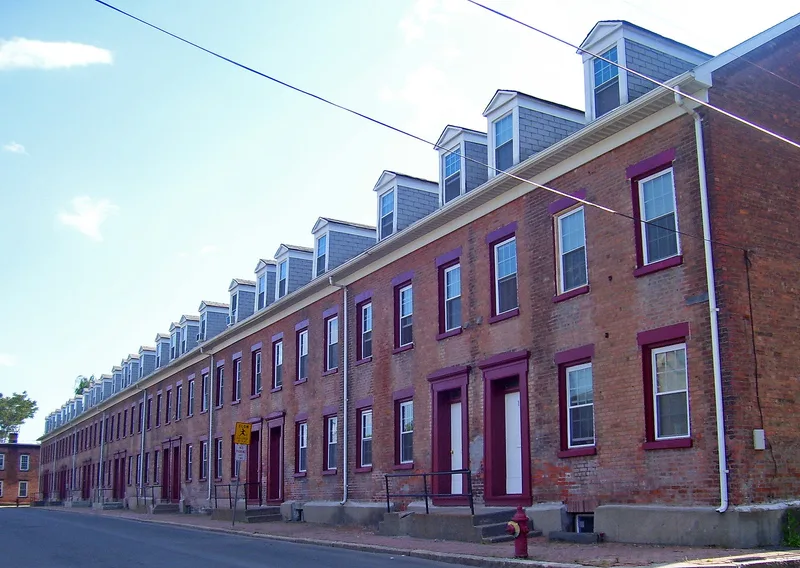
Olmstead Street in Cohoes, New York, curves along the path of a former power canal that once separated the living and working worlds of a textile community. On one side stands the Ogden Mill, a large brick cotton mill built in sections in 1844, 1846 and 1859. On the other are three blocks of brick row houses, two to three stories tall and notable for their uniform materials, scale and design. The Cohoes Company built the first mill beside an abandoned stretch of the Erie Canal that had been added to its power canal system. The row houses were built on a street named for Charles A. Olmstead, the company agent. In 1847 the Ogden Mills led the city in woven cotton production. The mills later passed to the Harmony Company, which joined them with the central section. The filled canal is being turned into a park, and the district still reads as a self-contained industrial community.
Machine-generated summary. This summary was generated by a language model from the official nomination document and has not been reviewed line by line by an editor. It may contain errors. Check the source document before relying on any detail. Source: nomination document (PDF) · catalog entry. Generated October 2026 (model claude-sonnet-5-5, prompt v1.0-2026-10-29).
| Period of significance | 19th Century (specific dates 1826, 1844, 1846, 1859) |
|---|---|
| Areas of significance | Industry, Commerce, Architecture |
| Acreage | 1 |
| Boundary source | not published |
| Full listing page | Olmstead Street Historic District (property record) |
What listing means for this property
This is a historic district. Buildings within its boundary are either contributing (they add to the district's significance) or non-contributing. Owners of contributing income-producing buildings can claim the 20% federal rehabilitation tax credit; homeowners should look at state credits. National Register districts impose no design review by themselves; a local historic district ordinance, if one exists, does (the difference explained).
General information, not legal or tax advice. Rules change; confirm with your State Historic Preservation Office or a qualified adviser.