Old Town Hall Historic District

The National Park Service has not published a boundary polygon for this district; the map shows the listed properties inside it and the district's reference point.
Why it's listed
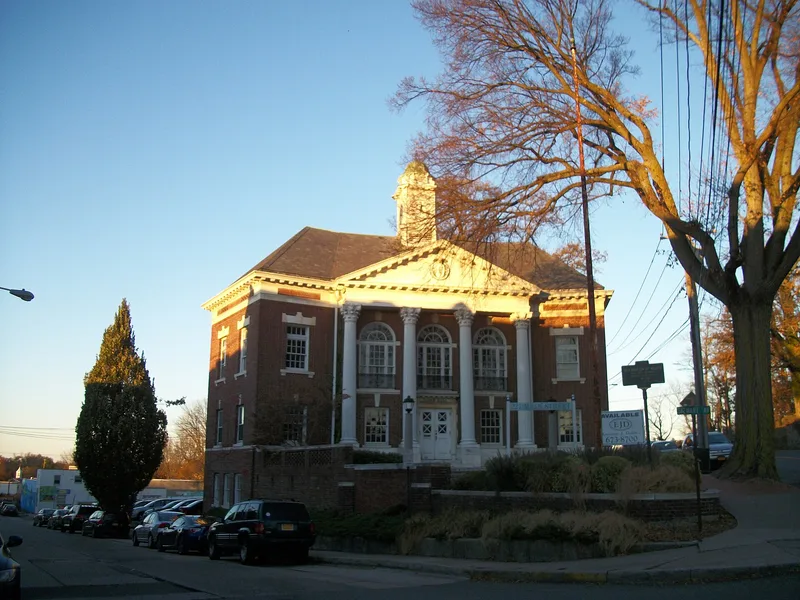
Huntington's civic heart sits on a hill known as "town hill," just east of the central business district. This five-acre district gathers ten contributing resources: eight buildings and two sites, spanning the 1653 settlement to the early twentieth century. At its center is the Old Burying Ground, which holds eighteenth and nineteenth-century sandstone and slate gravestones and the site of Fort Golgotha, a British fort built in 1782. Nearby are the 1837 Greek Revival Universalist Church, now a Daughters of the American Revolution chapter house, and three Queen Anne houses from about 1885 to 1895. Two Tudor Revival buildings by the New York firm Cady, Berg and See, the 1892 Soldiers and Sailors Memorial Building and the c.1900 Sewing and Trade School, stand close to the 1910 Neoclassical Town Hall designed by Julian Peabody. Together they form the largest collection of architect-designed buildings in the surrounding resource area and document the town's growth and prosperity.
Machine-generated summary. This summary was generated by a language model from the official nomination document and has not been reviewed line by line by an editor. It may contain errors. Check the source document before relying on any detail. Source: nomination document (PDF) · catalog entry. Generated October 2026 (model claude-sonnet-5-5, prompt v1.0-2026-10-29).
| Styles | Greek Revival, Queen Anne, Tudor Revival, Neoclassical |
|---|---|
| Areas of significance | Exploration/Settlement, Architecture |
| Acreage | 5 |
| Boundary source | not published |
| Full listing page | Old Town Hall Historic District (property record) |
What listing means for this property
This is a historic district. Buildings within its boundary are either contributing (they add to the district's significance) or non-contributing. Owners of contributing income-producing buildings can claim the 20% federal rehabilitation tax credit; homeowners should look at state credits. National Register districts impose no design review by themselves; a local historic district ordinance, if one exists, does (the difference explained).
General information, not legal or tax advice. Rules change; confirm with your State Historic Preservation Office or a qualified adviser.