Montour Falls Historic District

Why it's listed
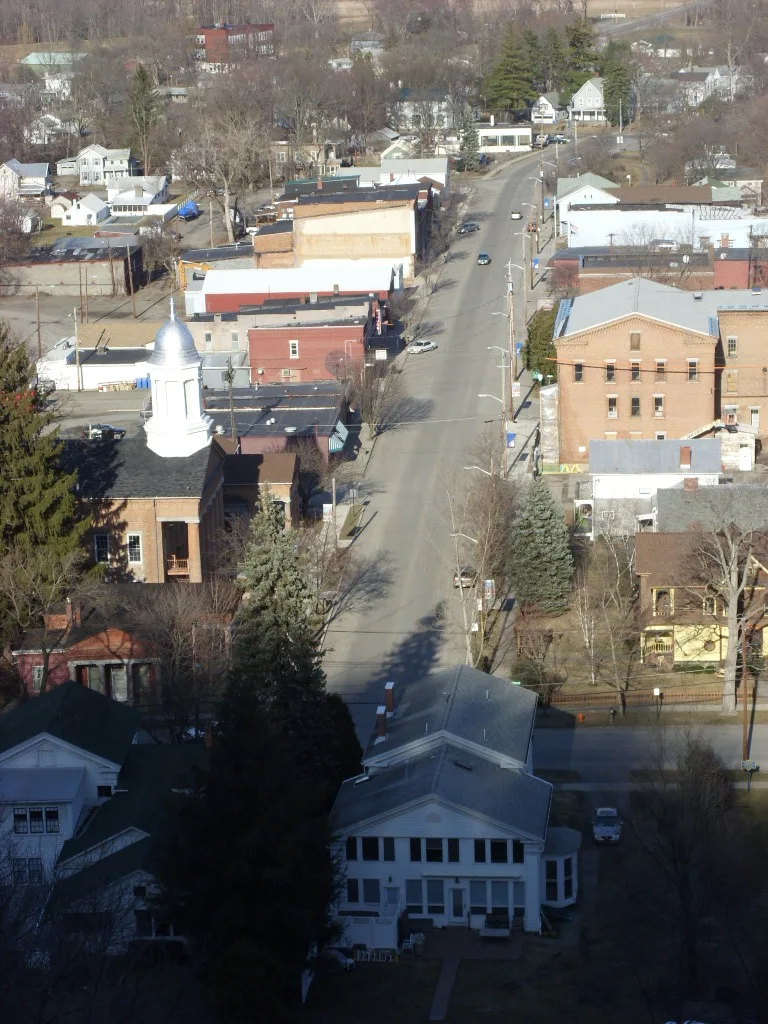
Montour Falls Historic District occupies about 13 acres at the foot of Chequaga Falls in Schuyler County, New York. It holds 24 mid- and late-nineteenth-century buildings, centered on a group of Greek Revival public buildings on West Main Street known locally as the "Glorious T." These include the former County Courthouse, now the Village Hall, the County Clerk's Office, the Sheriff's Office, the Memorial Library, St. Paul's Episcopal Church and the M&M Club, a former railroad hotel. Gillispie and Coreyell designed them in the 1850s and 1860s for Charles Cook, a canal contractor, entrepreneur and state senator who laid out the village and helped form Schuyler County in 1854. Genesee Street adds Greek Revival, Italian villa, shingle style and board-and-batten houses. The district was judged to illustrate community planning and craftsmanship in small southern tier towns, and it has no intrusions and only minor alterations.
Machine-generated summary. This summary was generated by a language model from the official nomination document and has not been reviewed line by line by an editor. It may contain errors. Check the source document before relying on any detail. Source: nomination document (PDF) · catalog entry. Generated October 2026 (model claude-sonnet-5-5, prompt v1.0-2026-10-29).
| Styles | Greek Revival (public buildings), with Italianate, Victorian, shingle style and vernacular houses |
|---|---|
| Areas of significance | Community Planning and Development, Historic - Aboriginal, Architecture |
| Acreage | 13 |
| Boundary source | NPS cultural-resource GIS polygon |
| Full listing page | Montour Falls Historic District (property record) |
What listing means for this property
This is a historic district. Buildings within its boundary are either contributing (they add to the district's significance) or non-contributing. Owners of contributing income-producing buildings can claim the 20% federal rehabilitation tax credit; homeowners should look at state credits. National Register districts impose no design review by themselves; a local historic district ordinance, if one exists, does (the difference explained).
General information, not legal or tax advice. Rules change; confirm with your State Historic Preservation Office or a qualified adviser.