Mill Street-North Clover Street Historic District

Why it's listed
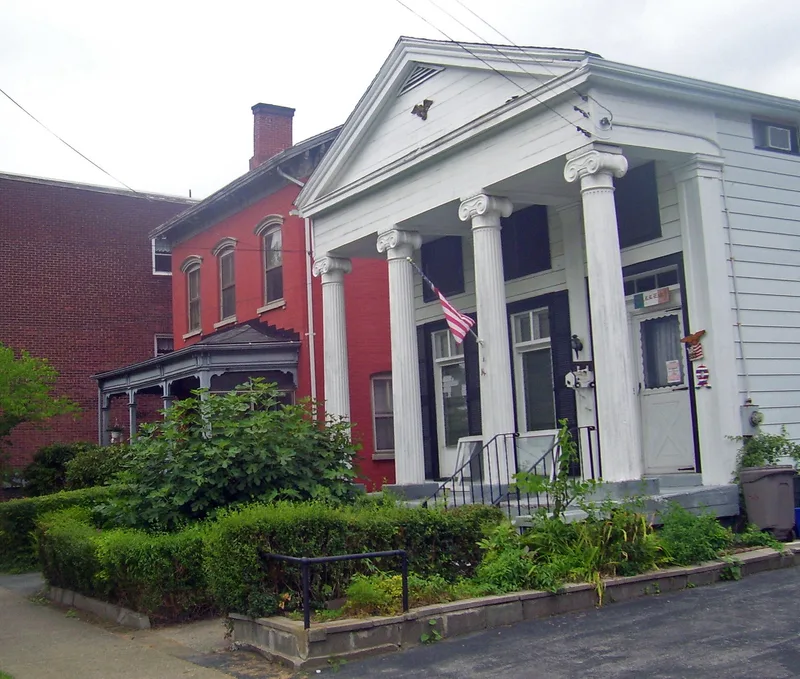
This residential district of about 14 blocks sits on the plateau and river slope of downtown Poughkeepsie. Two- and three-story single-family brick houses predominate, most built during a post-Civil War housing boom. Their facades are homogeneous, yet each house has its own trim, lintels, cornices and doors, and deep lots often hold elaborate gardens and grape arbors. Urban renewal clearance surrounds the area on three sides. Five buildings stand out individually: the Vassar Institute, the Vassar Home for Aged Men, Richard Upjohn's Church of the Holy Comforter, the Second Baptist Church (formerly the Vassar Temple) and a Queen Anne townhouse now used as the Italian Center. Mill Street, once a footpath, was the city's social center by the 1860s. The eastern portion became a civic and cultural hub under the Vassar family, with lectures, a literary club and a natural history museum at the Institute. The district is valued as a nearly intact 19th-century community of brick-paved streets.
Machine-generated summary. This summary was generated by a language model from the official nomination document and has not been reviewed line by line by an editor. It may contain errors. Check the source document before relying on any detail. Source: nomination document (PDF) · catalog entry. Generated October 2026 (model claude-sonnet-5-5, prompt v1.0-2026-10-29).
| Styles | Greek Revival to Italianate villas; Queen Anne townhouse |
|---|---|
| Areas of significance | Architecture, Religion, Social History |
| Acreage | 24 |
| Boundary source | NPS cultural-resource GIS polygon |
| Full listing page | Mill Street-North Clover Street Historic District (property record) |
What listing means for this property
This is a historic district. Buildings within its boundary are either contributing (they add to the district's significance) or non-contributing. Owners of contributing income-producing buildings can claim the 20% federal rehabilitation tax credit; homeowners should look at state credits. National Register districts impose no design review by themselves; a local historic district ordinance, if one exists, does (the difference explained).
General information, not legal or tax advice. Rules change; confirm with your State Historic Preservation Office or a qualified adviser.