Main Street Historic District

Why it's listed
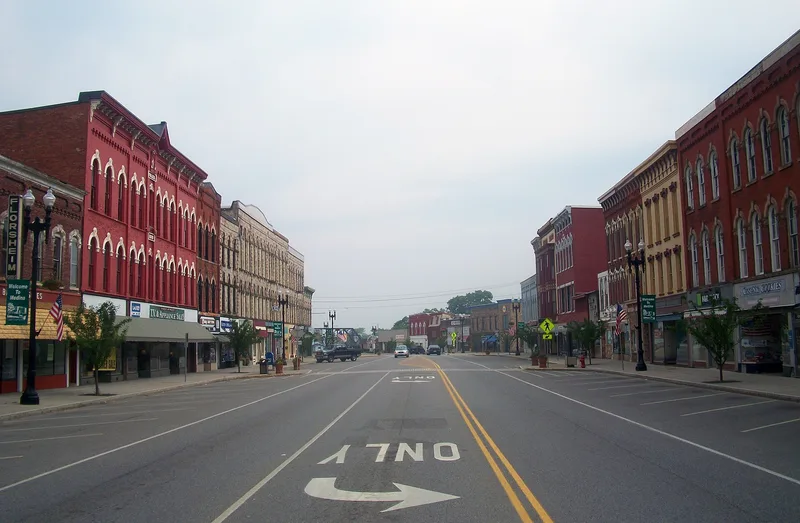
Medina's Main Street Historic District covers the village's commercial core in Orleans County, New York, near the Erie Canal turning basin. Its 49 contributing buildings, built between about 1845 and about 1910, are mostly attached two- and three-story structures of brick or locally quarried Medina sandstone. Italianate design is most common, with round or segmental arched windows, bracketed cornices and cast iron storefront pilasters. Other styles include Queen Anne, Romanesque Revival, Richardsonian Romanesque, Neoclassical and an Art Deco storefront. Notable buildings include Paddock's Hotel (1855), the Fuller Block (1875), First Presbyterian Church (1872), City Hall (1908), the former New York Central Railroad Station (1908) and sandstone cold storage warehouses at the south end. The district was listed because its buildings share scale, materials and rooflines, and many retain a high degree of historic integrity, particularly on the upper floors. Some storefronts have been sympathetically rehabilitated.
Machine-generated summary. This summary was generated by a language model from the official nomination document and has not been reviewed line by line by an editor. It may contain errors. Check the source document before relying on any detail. Source: nomination document (PDF) · catalog entry. Generated October 2026 (model claude-sonnet-5-5, prompt v1.0-2026-10-29).
| Styles | Late Victorian (Italianate, Queen Anne, Romanesque Revival, Richardsonian Romanesque); Early 20th Century Neoclassical |
|---|---|
| Areas of significance | Entertainment/Recreation, Politics/Government, Architecture, Commerce, Transportation, Agriculture |
| Acreage | 11.3 |
| Boundary source | NPS cultural-resource GIS polygon |
| Full listing page | Main Street Historic District (property record) |
What listing means for this property
This is a historic district. Buildings within its boundary are either contributing (they add to the district's significance) or non-contributing. Owners of contributing income-producing buildings can claim the 20% federal rehabilitation tax credit; homeowners should look at state credits. National Register districts impose no design review by themselves; a local historic district ordinance, if one exists, does (the difference explained).
General information, not legal or tax advice. Rules change; confirm with your State Historic Preservation Office or a qualified adviser.