Main Street Historic District

Why it's listed
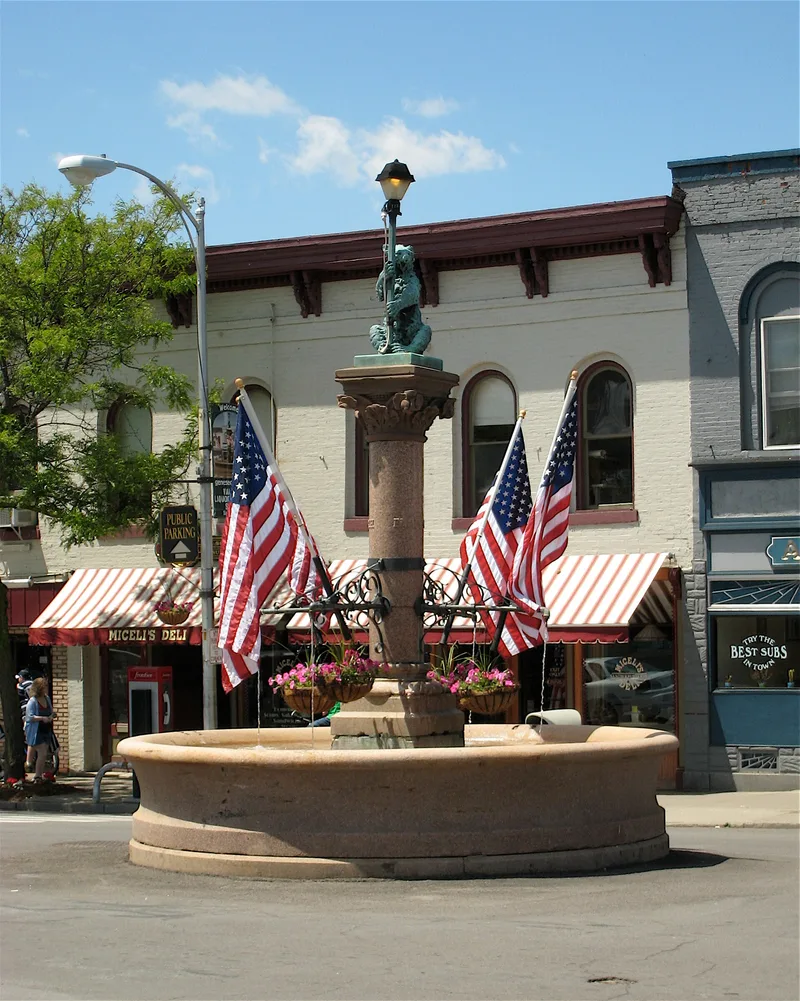
Main Street in Geneseo, New York, forms one long streetscape between the Livingston County Courthouse at the north end and the village park at the south. Residential and commercial buildings line both sides, mostly two or three stories, with houses standing alone and shops built in attached rows. The town was founded in 1790 by brothers James and William Wadsworth, and the street grew up between the 1821 courthouse and the town green, supported by churches, banks, hotels and manufacturers. The Erie Railroad arrived in 1859 and influenced its growth. The district displays Federal houses of about 1813 and 1815, a Greek Revival building with a concert hall, St. Michael's Church of 1866 in Gothic Revival style, a French Second Empire house of 1874, and an 1888 memorial fountain designed by Richard Morris Hunt. Gas stations and a few modern buildings intrude, but the street keeps a consistent sense of time and place.
Machine-generated summary. This summary was generated by a language model from the official nomination document and has not been reviewed line by line by an editor. It may contain errors. Check the source document before relying on any detail. Source: nomination document (PDF) · catalog entry. Generated October 2026 (model claude-sonnet-5-5, prompt v1.0-2026-10-29).
| Styles | Federal, Greek Revival, Italianate, Gothic Revival, French Second Empire, Queen Anne, Tudor, Classical Revival, and early modern |
|---|---|
| Areas of significance | Architecture |
| Acreage | 120 |
| Boundary source | NPS cultural-resource GIS polygon |
| Full listing page | Main Street Historic District (property record) |
What listing means for this property
This is a historic district. Buildings within its boundary are either contributing (they add to the district's significance) or non-contributing. Owners of contributing income-producing buildings can claim the 20% federal rehabilitation tax credit; homeowners should look at state credits. National Register districts impose no design review by themselves; a local historic district ordinance, if one exists, does (the difference explained).
General information, not legal or tax advice. Rules change; confirm with your State Historic Preservation Office or a qualified adviser.