Main Street Historic District

Why it's listed
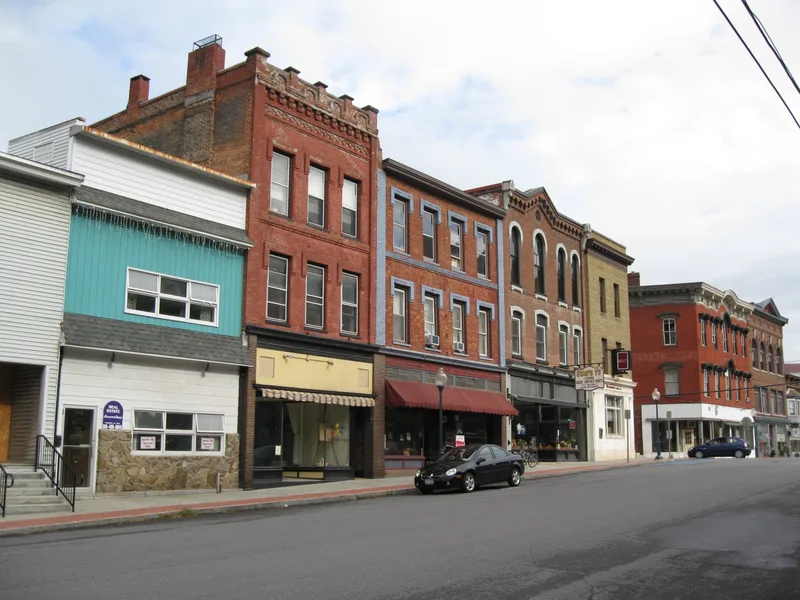
Three blocks of two- and three-story commercial buildings line Main Street in Whitehall, facing the Champlain Canal, with wooded hills rising behind them. The district includes about forty structures, most built of brick from two local brickyards, along with several buildings on Williams Street. Their details include mansard and flat roofs, arched tracery windows, decorative metal lintels, corbelled brick cornices and Italianate brackets. The street has served as a traffic route and business center since the lake-boat era, through the canal period that began in 1817 and the arrival of the railroad in 1846. A fire in 1864 destroyed much of the early commercial area, including mills, a foundry and a sash and door factory. Local architect Almon Chandler Hopson, who came from Vermont about 1862, rebuilt most of the buildings between 1865 and 1900, giving the street its unified appearance. Though shop fronts have been modernized, the district keeps the look of a nineteenth century canal town.
Machine-generated summary. This summary was generated by a language model from the official nomination document and has not been reviewed line by line by an editor. It may contain errors. Check the source document before relying on any detail. Source: nomination document (PDF) · catalog entry. Generated October 2026 (model claude-sonnet-5-5, prompt v1.0-2026-10-29).
| Period of significance | 19th Century (rebuilding 1865-1900) |
|---|---|
| Styles | Late nineteenth century commercial architecture with Italianate brackets, mansard roofs, arched tracery windows, decorative metal lintels and corbelled brick cornices |
| Areas of significance | Commerce, Architecture |
| Acreage | 11 |
| Boundary source | NPS cultural-resource GIS polygon |
| Full listing page | Main Street Historic District (property record) |
What listing means for this property
This is a historic district. Buildings within its boundary are either contributing (they add to the district's significance) or non-contributing. Owners of contributing income-producing buildings can claim the 20% federal rehabilitation tax credit; homeowners should look at state credits. National Register districts impose no design review by themselves; a local historic district ordinance, if one exists, does (the difference explained).
General information, not legal or tax advice. Rules change; confirm with your State Historic Preservation Office or a qualified adviser.