Main-Partition Streets Historic District

Why it's listed
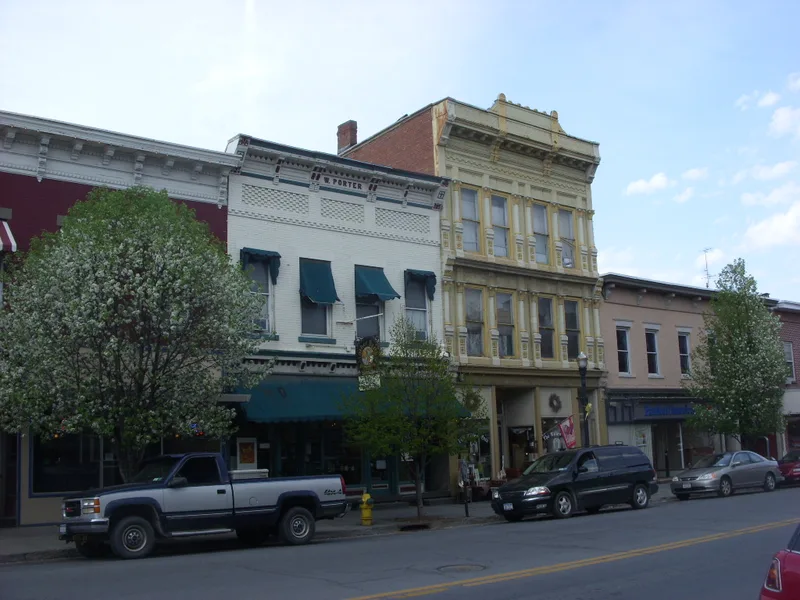
Saugerties' historic business core lies along Main, Partition, Market and Jane Streets, where 83 structures form a compact, small-scale commercial district above the mouth of the Esopus Creek. Most are two- or three-story brick stores with apartments or storage above, built mainly in the second half of the nineteenth century. The village grew from a small mill hamlet after businessman Henry Barclay established an iron works and paper mill in the 1820s, and later relied on bluestone shipping, brickmaking and tourism. Surviving landmarks include a 1780s public house, the 1827 Phoenix Hotel, the Exchange Hotel, and two churches in round-arched styles. Two storefronts have complete galvanized sheet-iron facades shipped from Mesker Brothers of St. Louis, and several Victorian buildings carry named, dated rooftop pediments. Bluestone sidewalks remain in front of most shops. Limited twentieth-century growth left few modern intrusions, so the streetscape still conveys a nineteenth-century riverside village.
Machine-generated summary. This summary was generated by a language model from the official nomination document and has not been reviewed line by line by an editor. It may contain errors. Check the source document before relying on any detail. Source: nomination document (PDF) · catalog entry. Generated October 2026 (model claude-sonnet-5-5, prompt v1.0-2026-10-29).
| Period of significance | c1780-1900 |
|---|---|
| Areas of significance | Commerce, Architecture |
| Acreage | 12 |
| Boundary source | NPS cultural-resource GIS polygon |
| Full listing page | Main-Partition Streets Historic District (property record) |
What listing means for this property
This is a historic district. Buildings within its boundary are either contributing (they add to the district's significance) or non-contributing. Owners of contributing income-producing buildings can claim the 20% federal rehabilitation tax credit; homeowners should look at state credits. National Register districts impose no design review by themselves; a local historic district ordinance, if one exists, does (the difference explained).
General information, not legal or tax advice. Rules change; confirm with your State Historic Preservation Office or a qualified adviser.