Houses at 1026-1028 Fifth Ave.

The National Park Service has not published a boundary polygon for this district; the map shows the listed properties inside it and the district's reference point.
Why it's listed
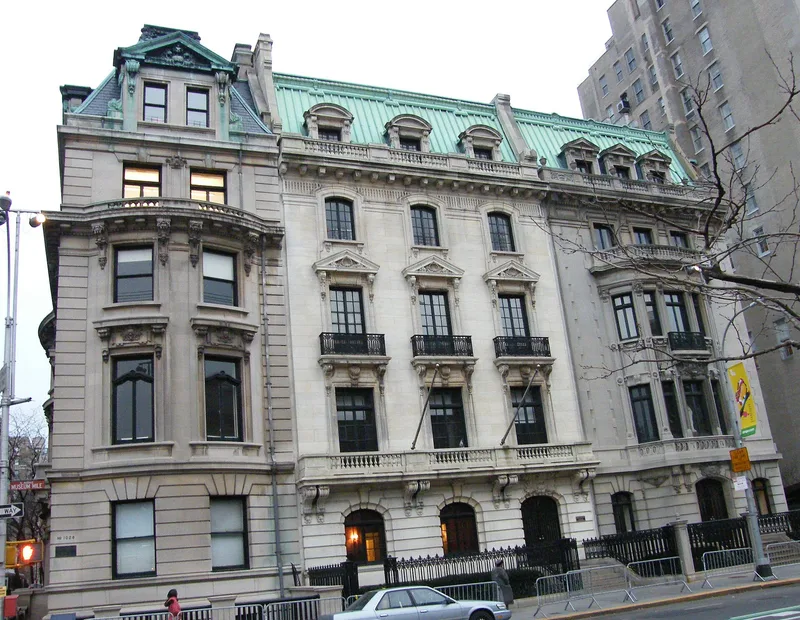
Three Beaux-Arts townhouses stand at 1026-1028 Fifth Avenue, on the corner of East 84th Street across from the Metropolitan Museum of Art. Built in 1901-03, the houses at 1026 and 1027 were designed by Van Vleck & Goldsmith for marble dealer Benjamin A. Williams, while 1028 was designed by C. P. H. Gilbert. Their facades combine limestone and marble, curved bays, rusticated ground floors, balustrades and copper or slate mansard roofs with pedimented dormers. Inside, the buildings keep much of their original finishes, including paneled rooms, ornate stairhalls, marble fireplaces and a basement kitchen. Fifth Avenue once held many comparable mansions, and this row is one of the few groups of turn-of-the-century residences left on the avenue. The Marymount School began converting the houses to school use in 1926 with the purchase of 1028, and the buildings are now joined internally. Their architecture and high level of preservation are the basis for their listing.
Machine-generated summary. This summary was generated by a language model from the official nomination document and has not been reviewed line by line by an editor. It may contain errors. Check the source document before relying on any detail. Source: nomination document (PDF) · catalog entry. Generated October 2026 (model claude-sonnet-5-5, prompt v1.0-2026-10-29).
| Period of significance | 1901-03 |
|---|---|
| Styles | Late 19th & 20th Century Revivals: Beaux-Arts |
| Areas of significance | Architecture |
| Acreage | 0.9 |
| Boundary source | not published |
| Full listing page | Houses at 1026-1028 Fifth Ave. (property record) |
What listing means for this property
This is a historic district. Buildings within its boundary are either contributing (they add to the district's significance) or non-contributing. Owners of contributing income-producing buildings can claim the 20% federal rehabilitation tax credit; homeowners should look at state credits. National Register districts impose no design review by themselves; a local historic district ordinance, if one exists, does (the difference explained).
General information, not legal or tax advice. Rules change; confirm with your State Historic Preservation Office or a qualified adviser.