Holland Patent Stone Churches Historic District

The National Park Service has not published a boundary polygon for this district; the map shows the listed properties inside it and the district's reference point.
Why it's listed
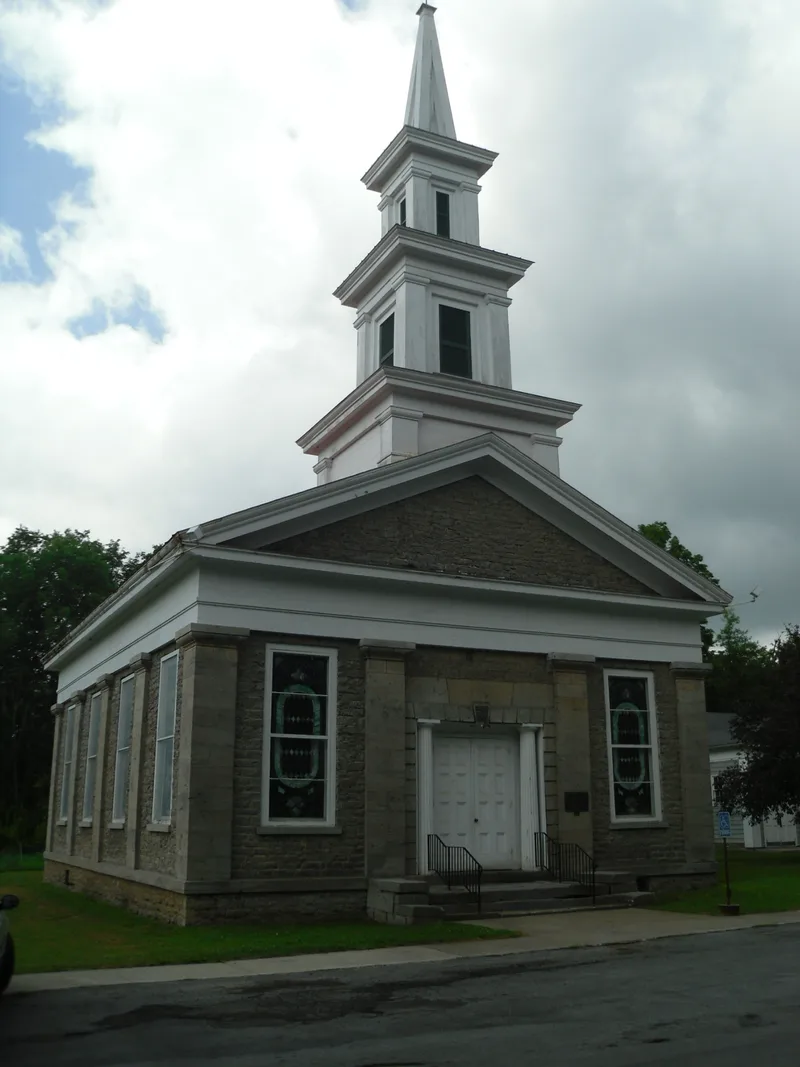
Four limestone churches and a village green form this historic district in Holland Patent, Oneida County. The green was set aside as a 7.5-acre public square in 1798 by the first settlers, who came from Connecticut and followed New England planning traditions. Around it rose the Unitarian church (1842), the Presbyterian church (1843), the Baptist church (1844) and the Welsh Congregational church, remodeled from an older stone building in 1858. All are Greek Revival buildings of locally quarried Trenton limestone, with pedimented gable fronts, heavy cornices and Doric or Ionic detailing. Local masons Charles Ackley and Andrew Rockwell built two of them. Only the Presbyterian church still serves its original purpose; the others now serve as a parish hall and as homes. The Welsh church is the last reminder of a once-thriving Welsh community. The green was landscaped over the later nineteenth century and gained an octagonal bandstand in the 1890s.
Machine-generated summary. This summary was generated by a language model from the official nomination document and has not been reviewed line by line by an editor. It may contain errors. Check the source document before relying on any detail. Source: nomination document (PDF) · catalog entry. Generated October 2026 (model claude-sonnet-5-5, prompt v1.0-2026-10-29).
| Period of significance | 1798-1900 |
|---|---|
| Styles | Mid-Nineteenth Century; Greek Revival |
| Areas of significance | Community Planning and Development, European, Exploration/Settlement, Architecture |
| Acreage | 5 |
| Boundary source | not published |
| Full listing page | Holland Patent Stone Churches Historic District (property record) |
What listing means for this property
This is a historic district. Buildings within its boundary are either contributing (they add to the district's significance) or non-contributing. Owners of contributing income-producing buildings can claim the 20% federal rehabilitation tax credit; homeowners should look at state credits. National Register districts impose no design review by themselves; a local historic district ordinance, if one exists, does (the difference explained).
General information, not legal or tax advice. Rules change; confirm with your State Historic Preservation Office or a qualified adviser.