Harmony Mill Historic District

Why it's listed
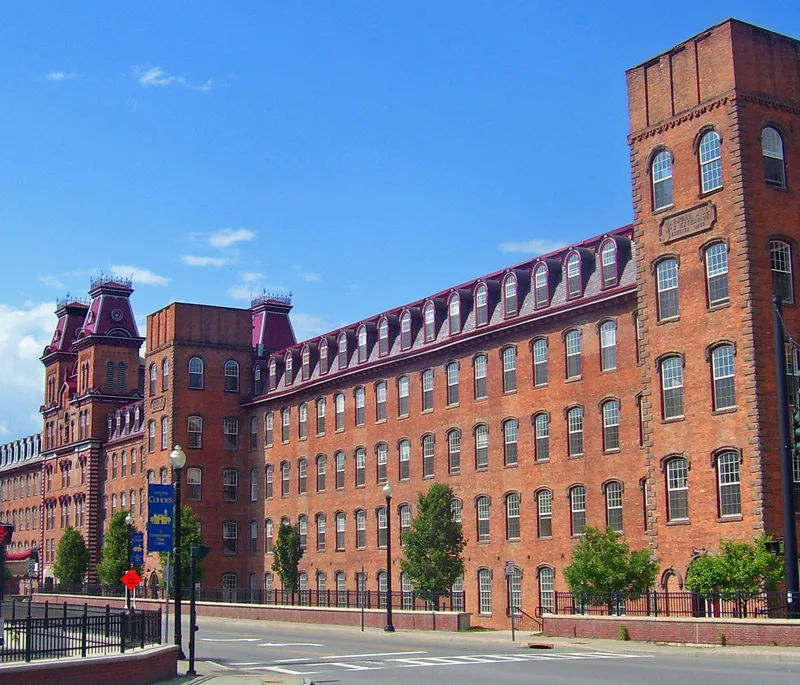
Harmony Mill Historic District occupies a narrow shelf of land on the edge of an embankment above Cohoes Falls and the Mohawk River in Cohoes, New York. Five surviving mills form two rows parallel to the river. West and slightly south of them, a large neighborhood of brick and wood factory housing climbs the hill, known as Prospect Hill and Harmony Hill, where the street grid bends to fit the slope. The earliest housing is three blocks of two-and-one-half-story brick houses along Harmony Street, some with Greek Revival entrance trim. More plain brick and frame housing followed on Summit Street by 1866. The neighborhood also includes an old tavern, a church, a school and Johnston Hall, a rambling three-story brick Italianate mansion with a mansard roof, built for mill manager D.J. Johnston on a bluff overlooking the mills. The district extends north to include the Falls and was previously documented in a 1969 survey of the Mohawk-Hudson area.
Machine-generated summary. This summary was generated by a language model from the official nomination document and has not been reviewed line by line by an editor. It may contain errors. Check the source document before relying on any detail. Source: nomination document (PDF) · catalog entry. Generated October 2026 (model claude-sonnet-5-5, prompt v1.0-2026-10-29).
| Styles | Greek Revival trim on some of the earliest housing; Italianate for Johnston Hall (brick, three stories, mansard roof, hooded dormers) |
|---|---|
| Areas of significance | Industry, Architecture |
| Acreage | 120 |
| Boundary source | NPS cultural-resource GIS polygon |
| Full listing page | Harmony Mill Historic District (property record) |
What listing means for this property
This is a historic district. Buildings within its boundary are either contributing (they add to the district's significance) or non-contributing. Owners of contributing income-producing buildings can claim the 20% federal rehabilitation tax credit; homeowners should look at state credits. National Register districts impose no design review by themselves; a local historic district ordinance, if one exists, does (the difference explained).
General information, not legal or tax advice. Rules change; confirm with your State Historic Preservation Office or a qualified adviser.