Hamilton Heights Historic District

Why it's listed
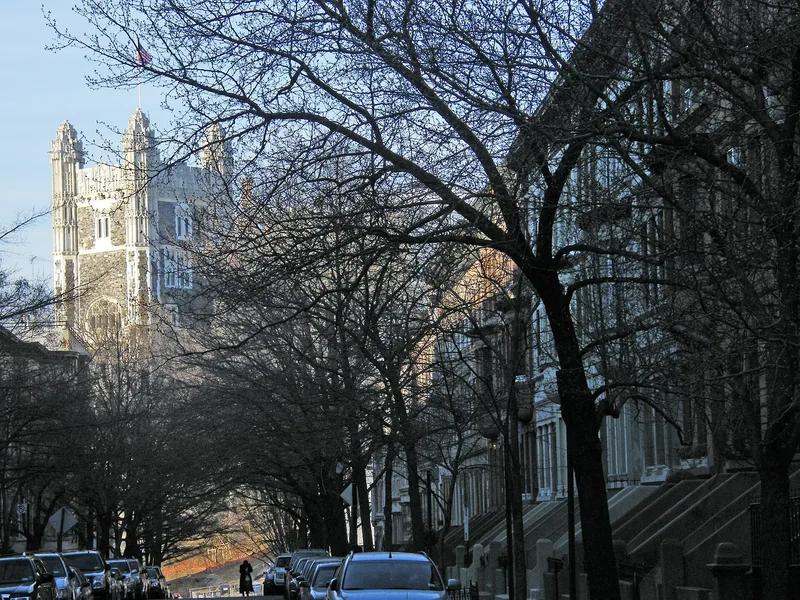
Hamilton Heights is a Manhattan neighborhood of tree-shaded streets lined with three- and four-story row houses, set behind raised stone terraces. It lies between West 140th and West 145th Streets, east and west of Convent Avenue, which forms its spine. Convent Avenue and Hamilton Terrace were laid out as dead ends, giving the area the feel of a protected enclave within the city. The houses date mainly from the late 19th and early 20th centuries and show a range of styles. Beaux Arts rows on West 140th and 141st Streets were built for developer Gustavus L. Lawrence to designs by Neville & Bagge, with alternating red and buff brick fronts and curved or three-sided bays. Romanesque Revival brownstones on West 141st Street were designed by John C. Burne. Three corner churches, St. Luke's, Convent Avenue Baptist and St. James' Presbyterian, mark the edges of the district and add vertical accents. Matching rows by the same designers give the streets an unusually harmonious appearance.
Machine-generated summary. This summary was generated by a language model from the official nomination document and has not been reviewed line by line by an editor. It may contain errors. Check the source document before relying on any detail. Source: nomination document (PDF) · catalog entry. Generated October 2026 (model claude-sonnet-5-5, prompt v1.0-2026-10-29).
| Styles | Beaux Arts, Romanesque Revival and neo-Gothic row houses and churches |
|---|---|
| Areas of significance | Architecture |
| Boundary source | NPS cultural-resource GIS polygon |
| Full listing page | Hamilton Heights Historic District (property record) |
What listing means for this property
This is a historic district. Buildings within its boundary are either contributing (they add to the district's significance) or non-contributing. Owners of contributing income-producing buildings can claim the 20% federal rehabilitation tax credit; homeowners should look at state credits. National Register districts impose no design review by themselves; a local historic district ordinance, if one exists, does (the difference explained).
General information, not legal or tax advice. Rules change; confirm with your State Historic Preservation Office or a qualified adviser.