Hait, Thaddeus, Farm

Why it's listed
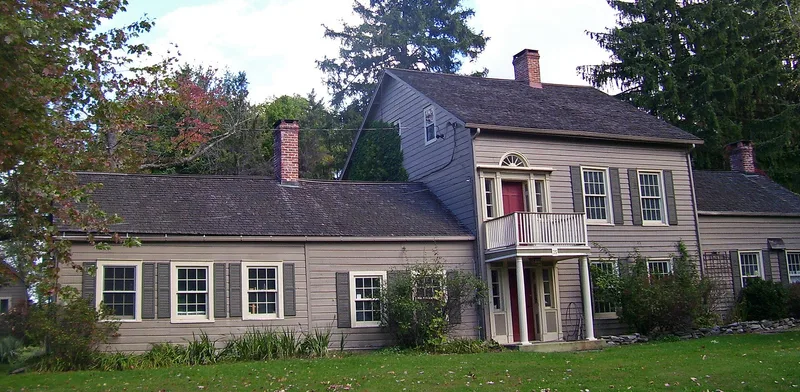
Along Allhusen Road, the former Milton Turnpike near Modena in Ulster County, New York, this 142-acre farm holds fifteen historic resources in two groups: a house complex and a barn complex. The centerpiece is a small, two-story Federal style farmhouse of about 1825, built partly of wood frame and partly of fieldstone and set into a hillside. Its interior keeps fine woodwork, including Adamesque mantels built for stoves and a formal parlor on the second floor. The barn group includes a Dutch barn with a massive hand-hewn H-frame, expanded in several stages, alongside a granary, ice house and other sheds. A fieldstone barn, a stone smokehouse, a house foundation and a stone-lined well add to the ensemble. The property was listed because these buildings together show regional building traditions and changing farming practices from roughly 1775 to 1930. The land remains in agricultural use, and the Dutch barn now serves a winery while keeping its original framing visible.
Machine-generated summary. This summary was generated by a language model from the official nomination document and has not been reviewed line by line by an editor. It may contain errors. Check the source document before relying on any detail. Source: nomination document (PDF) · catalog entry. Generated October 2026 (model claude-sonnet-5-5, prompt v1.0-2026-10-29).
| Period of significance | circa 1775-1930 |
|---|---|
| Styles | Early Republic/Federal; Colonial/Dutch Colonial |
| Areas of significance | Agriculture, Architecture |
| Acreage | 142 |
| Boundary source | NPS cultural-resource GIS polygon |
| Full listing page | Hait, Thaddeus, Farm (property record) |
What listing means for this property
This is a historic district. Buildings within its boundary are either contributing (they add to the district's significance) or non-contributing. Owners of contributing income-producing buildings can claim the 20% federal rehabilitation tax credit; homeowners should look at state credits. National Register districts impose no design review by themselves; a local historic district ordinance, if one exists, does (the difference explained).
General information, not legal or tax advice. Rules change; confirm with your State Historic Preservation Office or a qualified adviser.