Grasmere

Why it's listed
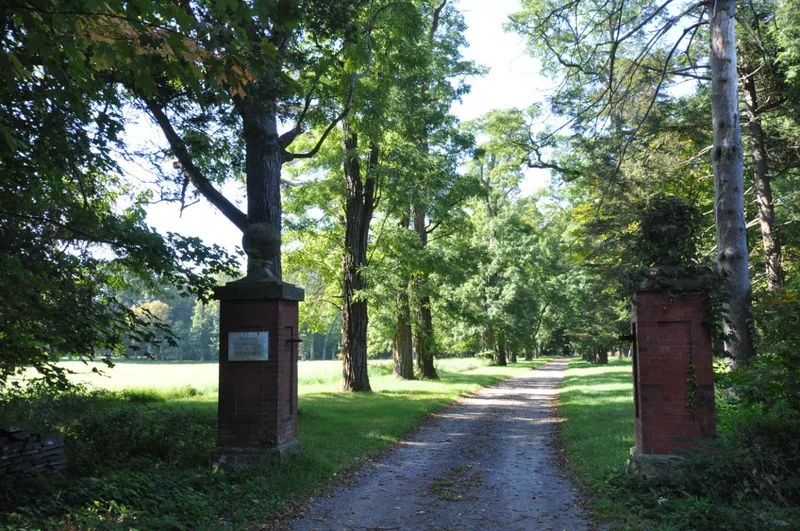
Grasmere is an estate of roughly sixty acres just south of Rhinebeck village, built around a three-story brick manor house. The core of the house dates to about 1824, when Peter R. Livingston rebuilt it on the site of a Georgian mansion begun by General Richard Montgomery and Janet Livingston Montgomery and destroyed by fire in 1823. A third story was added in 1861-2, and a west wing followed in the early twentieth century. Two stuccoed tenant houses of about 1916 mark the northern end of the property. To the south, a large stone barn and stable complex from about 1901 sits with sheds and corn cribs. Remains of formal gardens, including a brick balustrade, a stone pond and stone gateposts, show how the landscape shifted from formal to picturesque and back to formal. The estate matters for its link to leading Hudson Valley families and as a surviving example of how a country seat became a working farm.
Machine-generated summary. This summary was generated by a language model from the official nomination document and has not been reviewed line by line by an editor. It may contain errors. Check the source document before relying on any detail. Source: nomination document (PDF) · catalog entry. Generated October 2026 (model claude-sonnet-5-5, prompt v1.0-2026-10-29).
| Styles | Federal style manor house with later classically inspired additions; medieval-inspired stone barn |
|---|---|
| Areas of significance | Architecture, Social History |
| Acreage | 60 |
| Boundary source | NPS cultural-resource GIS polygon |
| Full listing page | Grasmere (property record) |
What listing means for this property
This is a historic district. Buildings within its boundary are either contributing (they add to the district's significance) or non-contributing. Owners of contributing income-producing buildings can claim the 20% federal rehabilitation tax credit; homeowners should look at state credits. National Register districts impose no design review by themselves; a local historic district ordinance, if one exists, does (the difference explained).
General information, not legal or tax advice. Rules change; confirm with your State Historic Preservation Office or a qualified adviser.