Forest-Norman Historic District

The National Park Service has not published a boundary polygon for this district; the map shows the listed properties inside it and the district's reference point.
Why it's listed
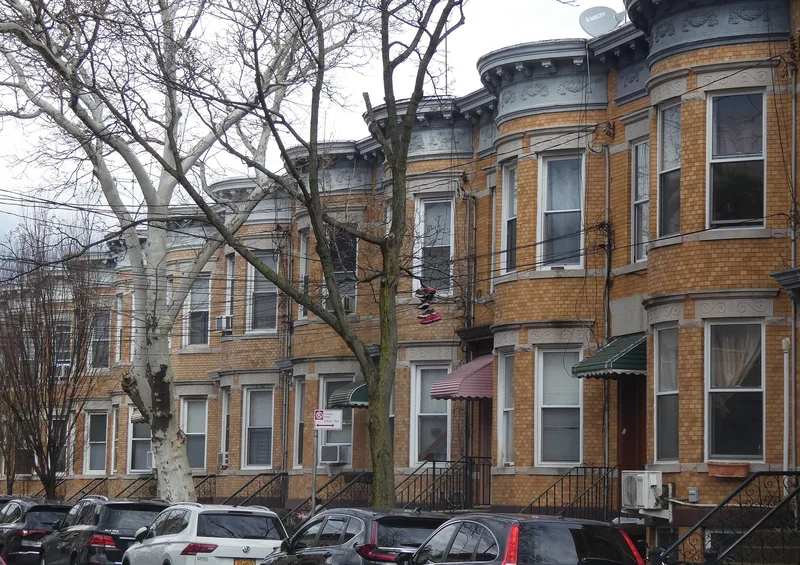
Thirty-seven buildings along Forest Avenue and Norman Street in Ridgewood, Queens, form a compact three-acre district of early twentieth-century working-class housing. Built between 1908 and 1910, the group consists mainly of two-story brick row houses with one apartment per floor, plus two-story brick tenements with two apartments per floor. Several builders worked to a common scheme of setbacks, scale and materials, and used Romanesque and Renaissance Revival ornament. Louis Berger, described as Ridgewood's most prolific architect, designed notable rows, including 59-02 to 59-28 Norman Street, built by Henn and Ballweg in 1910 with burnt orange brick and tinted mortar, and a Forest Avenue row built by J. and G. Burkardt in 1908 with checker-bonded brick. Unbroken lines of pressed metal cornices and ornamental ironwork unify the streets. All cornices survive, along with most original doors, ironwork and stoops, and no buildings within the boundaries are considered non-contributing.
Machine-generated summary. This summary was generated by a language model from the official nomination document and has not been reviewed line by line by an editor. It may contain errors. Check the source document before relying on any detail. Source: nomination document (PDF) · catalog entry. Generated October 2026 (model claude-sonnet-5-5, prompt v1.0-2026-10-29).
| Period of significance | 1908-1910 |
|---|---|
| Styles | Romanesque and Renaissance Revival ornament (Neo Grec and Renaissance Revival on part of Norman St.) |
| Areas of significance | Architecture |
| Acreage | 3 |
| Boundary source | not published |
| Full listing page | Forest-Norman Historic District (property record) |
What listing means for this property
This is a historic district. Buildings within its boundary are either contributing (they add to the district's significance) or non-contributing. Owners of contributing income-producing buildings can claim the 20% federal rehabilitation tax credit; homeowners should look at state credits. National Register districts impose no design review by themselves; a local historic district ordinance, if one exists, does (the difference explained).
General information, not legal or tax advice. Rules change; confirm with your State Historic Preservation Office or a qualified adviser.