Earlville Historic District
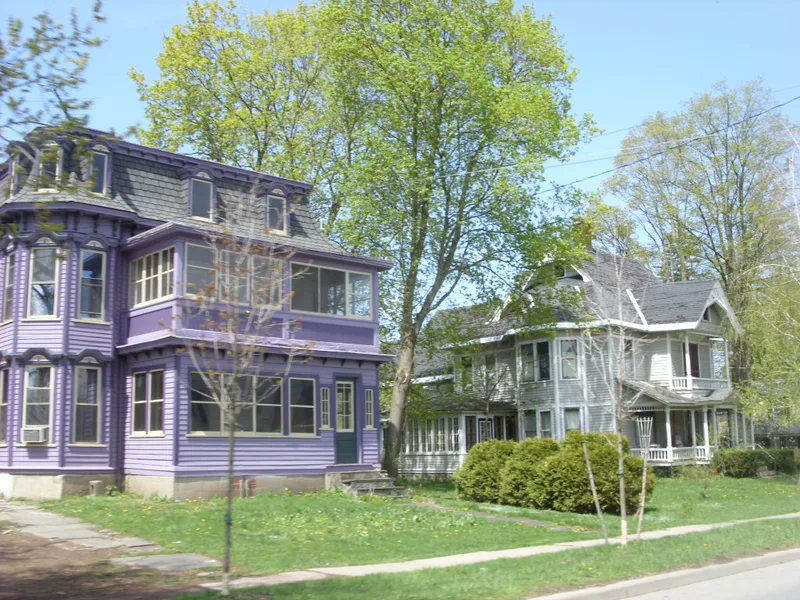

Why it's listed
Earlville's historic district covers roughly 165 properties at the heart of a village that sits on the line between Chenango and Madison counties in New York. The center line of Main Street marks the county boundary. The commercial core, a group of two-story brick blocks, was rebuilt in the 1880s after a series of disastrous fires, and includes the Opera House and Douglass Block, the Second Empire Odd Fellows Hall and three surviving churches. Surrounding streets hold mostly wood-frame houses, with Federal and Greek Revival homes at the edges and Italianate, Queen Anne, Second Empire and locally named Stafford houses from the late nineteenth century. Slate sidewalks, shade trees and original carriage houses add to the setting. The village grew along the early turnpikes and then the Chenango Canal, completed in 1836, after which it took its name from canal commissioner Jonas Earl. Few modern intrusions exist, and the boundary excludes most altered buildings.
Machine-generated summary. This summary was generated by a language model from the official nomination document and has not been reviewed line by line by an editor. It may contain errors. Check the source document before relying on any detail. Source: nomination document (PDF) · catalog entry. Generated October 2026 (model claude-sonnet-5-5, prompt v1.0-2026-10-29).
| Styles | Variety of styles, predominantly eclectic late nineteenth-century (Italianate, Second Empire, Queen Anne, Victorian Gothic), with Federal and Greek Revival examples |
|---|---|
| Areas of significance | Architecture |
| Acreage | 85 |
| Boundary source | NPS cultural-resource GIS polygon |
| Full listing page | Earlville Historic District (property record) |
What listing means for this property
This is a historic district. Buildings within its boundary are either contributing (they add to the district's significance) or non-contributing. Owners of contributing income-producing buildings can claim the 20% federal rehabilitation tax credit; homeowners should look at state credits. National Register districts impose no design review by themselves; a local historic district ordinance, if one exists, does (the difference explained).
General information, not legal or tax advice. Rules change; confirm with your State Historic Preservation Office or a qualified adviser.