Drovers Inn and Round Family Residence

The National Park Service has not published a boundary polygon for this district; the map shows the listed properties inside it and the district's reference point.
Why it's listed
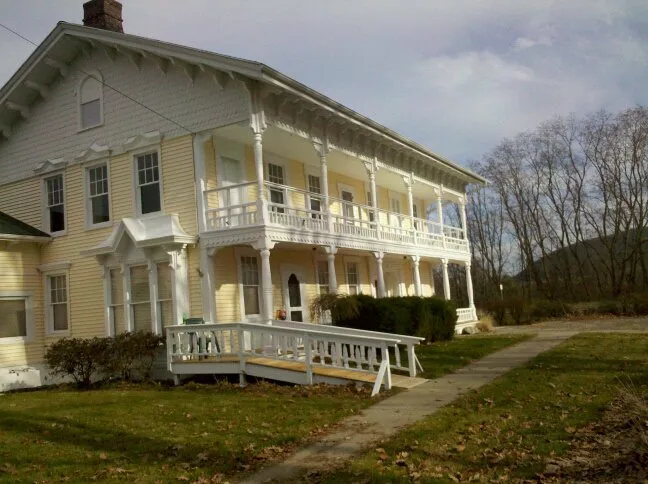
Two buildings on Pumphouse Road in Vestal, New York, record a century of use by one local family. The Drovers Inn was built in 1844 by Ransom Baty Sr. for brothers John D. and Jacob L. Rounds, near a river crossing on the Susquehanna. It served travelers and farmers driving livestock to market. Its Greek Revival form, long rectangular plan and two-story veranda were later overlaid with ornate Victorian decoration around 1880. The inn closed in 1855 and became a family home, then later a funeral home, apartments and a restaurant. Across the road stands the Queen Anne style Rounds Family Residence, built in 1895 for Fayette L. Rounds, the Vestal railroad station master, and designed by Truman I. Lacey. An engaged tower was added in 1912. The house remained in the family until 2001 and retains elaborate original interior finishes. Both buildings are now vacant. Together they illustrate the Rounds family's long presence at this site and the town's growth.
Machine-generated summary. This summary was generated by a language model from the official nomination document and has not been reviewed line by line by an editor. It may contain errors. Check the source document before relying on any detail. Source: nomination document (PDF) · catalog entry. Generated October 2026 (model claude-sonnet-5-5, prompt v1.0-2026-10-29).
| Period of significance | 1844-c1912 |
|---|---|
| Styles | Greek Revival with c1880 Victorian/Eastlake overlay (Drovers Inn); Queen Anne (Rounds Family Residence) |
| Areas of significance | Architecture, Social History |
| Acreage | 5 |
| Boundary source | not published |
| Full listing page | Drovers Inn and Round Family Residence (property record) |
What listing means for this property
This is a historic district. Buildings within its boundary are either contributing (they add to the district's significance) or non-contributing. Owners of contributing income-producing buildings can claim the 20% federal rehabilitation tax credit; homeowners should look at state credits. National Register districts impose no design review by themselves; a local historic district ordinance, if one exists, does (the difference explained).
Noted as vacant in the nomination. Nomination documents can be decades old; current status may differ. If you are considering buying an empty listed property, read the due-diligence checklist.
General information, not legal or tax advice. Rules change; confirm with your State Historic Preservation Office or a qualified adviser.