Downtown Cohoes Historic District

Why it's listed
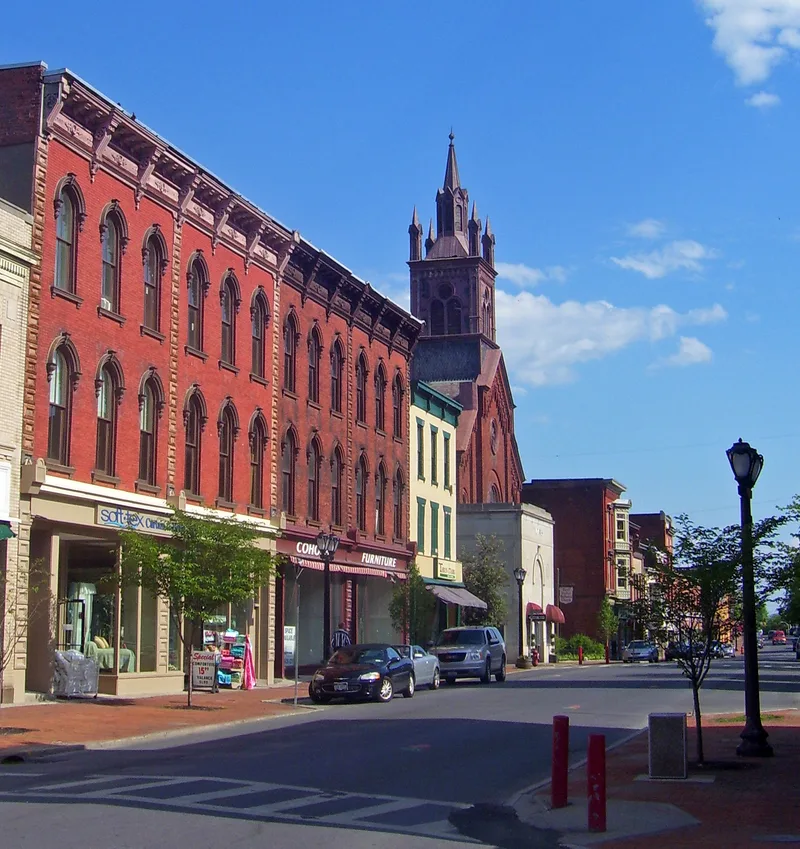
Downtown Cohoes is a 35-acre historic district in Albany County, New York, covering the commercial and civic center of a former mill city. Of its 165 properties, 70 are commercial buildings, 75 are residences, 12 are public buildings including six churches, a train station and city hall, and eight are industrial or utility structures. Remsen Street forms its central axis. Most buildings are two-to-four-story brick structures with bracketed cornices and hood moldings in the Italianate and Second Empire styles. Early survivors include a 1820s duplex on White Street and a Federal house built in 1836 by the carpenter Joshua Clarke. The Cohoes Music Hall and Silliman Memorial Presbyterian Church are individually listed. Growth tied to the first industrial ventures, the enlarged Erie Canal and the 1848 incorporation of the village shaped the street plan. Because building nearly stopped in the 1930s, many prosperous-era buildings survive, giving the district its period of significance of 1820 to 1930.
Machine-generated summary. This summary was generated by a language model from the official nomination document and has not been reviewed line by line by an editor. It may contain errors. Check the source document before relying on any detail. Source: nomination document (PDF) · catalog entry. Generated October 2026 (model claude-sonnet-5-5, prompt v1.0-2026-10-29).
| Period of significance | 1820-1930 |
|---|---|
| Styles | Italianate and Second Empire predominate, with Federal, Greek Revival, Queen Anne, Gothic Revival, Romanesque Revival, Chateauesque, Beaux-Arts, Neoclassical and Art Moderne examples |
| Areas of significance | Industry, Commerce, Architecture |
| Acreage | 35 |
| Boundary source | NPS cultural-resource GIS polygon |
| Full listing page | Downtown Cohoes Historic District (property record) |
What listing means for this property
This is a historic district. Buildings within its boundary are either contributing (they add to the district's significance) or non-contributing. Owners of contributing income-producing buildings can claim the 20% federal rehabilitation tax credit; homeowners should look at state credits. National Register districts impose no design review by themselves; a local historic district ordinance, if one exists, does (the difference explained).
General information, not legal or tax advice. Rules change; confirm with your State Historic Preservation Office or a qualified adviser.