City Hall Historic District

The National Park Service has not published a boundary polygon for this district; the map shows the listed properties inside it and the district's reference point.
Why it's listed
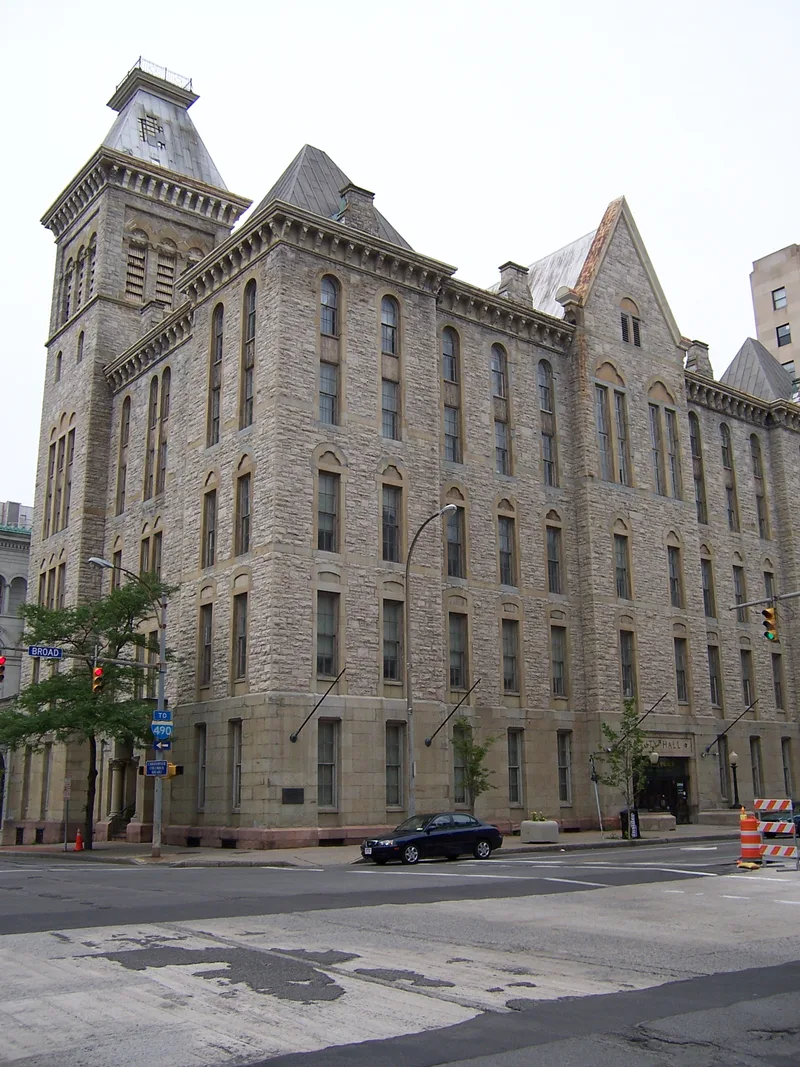
Four buildings on South Fitzhugh Street in downtown Rochester form a compact civic group beside the old Erie Canal route, now Broad Street. The Monroe County Courthouse, built of New Hampshire granite in 1894-96, and City Hall, built in 1874-75 of Lockport greystone, face each other's ends and are joined by a one-story arcaded link added in 1926. Across the street stand the Rochester Free Academy, a red brick Ruskinian Gothic school from 1872-73 now used by the Board of Education, and St. Luke's Episcopal Church, begun in the 1820s with limestone from Auburn. Architect A. J. Warner designed the academy and City Hall, and his son J. Foster Warner is credited with a third building. The group was listed because it shows Gothic Revival design across half a century and gathers government, education and religion in one tightly knit nineteenth-century setting.
Machine-generated summary. This summary was generated by a language model from the official nomination document and has not been reviewed line by line by an editor. It may contain errors. Check the source document before relying on any detail. Source: nomination document (PDF) · catalog entry. Generated October 2026 (model claude-sonnet-5-5, prompt v1.0-2026-10-29).
| Period of significance | 1872-75 |
|---|---|
| Styles | Gothic Revival, Ruskinian Gothic, Italian Renaissance elements |
| Areas of significance | Architecture |
| Acreage | 3 |
| Boundary source | not published |
| Full listing page | City Hall Historic District (property record) |
What listing means for this property
This is a historic district. Buildings within its boundary are either contributing (they add to the district's significance) or non-contributing. Owners of contributing income-producing buildings can claim the 20% federal rehabilitation tax credit; homeowners should look at state credits. National Register districts impose no design review by themselves; a local historic district ordinance, if one exists, does (the difference explained).
General information, not legal or tax advice. Rules change; confirm with your State Historic Preservation Office or a qualified adviser.