Campbell-Whittlesey House

The National Park Service has not published a boundary polygon for this district; the map shows the listed properties inside it and the district's reference point.
Why it's listed
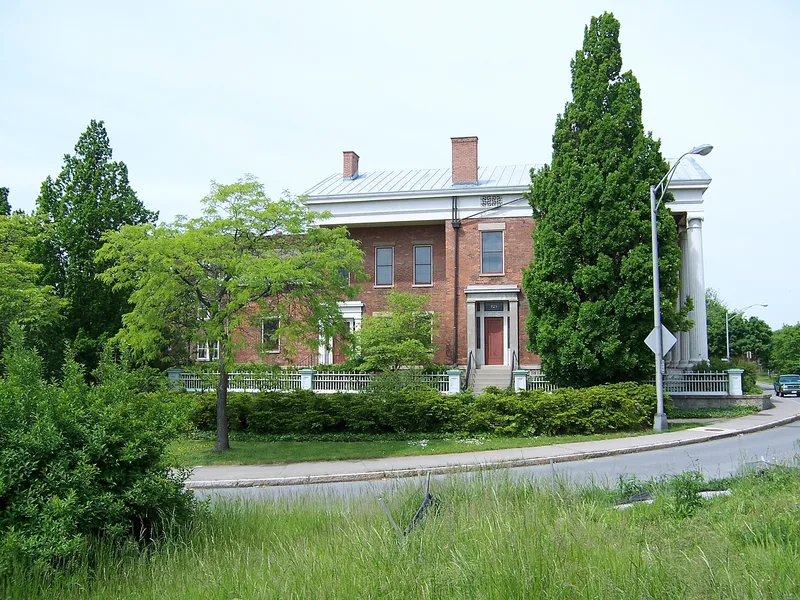
Built in 1835-1836 by Benjamin Campbell, a pioneer merchant and miller, this two-story brick mansion in Rochester's historic third ward is a notable example of Greek Revival design. A two-story pedimented Ionic portico with four columns spans the four-bay front, and the gabled roofs, wooden cornice and brick bearing walls complete a rectangular plan with a one-story rear section. The plans were either inspired or furnished by Minard Lafever, whose 1835 builder's guide, The Beauties of Modern Architecture, relates to the interior trim. The house recalls Rochester's flour milling industry, which relied on the Genesee River and its falls. In 1852 it passed to Frederick Whittlesey, a prominent lawyer and Vice Chancellor of the New York State Court of Chancery, and stayed in his family until 1937, when The Landmark Society of Western New York acquired it. The society restored the interior using original paint colors, furnished it in Greek Revival style, and planted period herbs and shrubs.
Machine-generated summary. This summary was generated by a language model from the official nomination document and has not been reviewed line by line by an editor. It may contain errors. Check the source document before relying on any detail. Source: nomination document (PDF) · catalog entry. Generated October 2026 (model claude-sonnet-5-5, prompt v1.0-2026-10-29).
| Period of significance | 19th Century (specific date 1835) |
|---|---|
| Styles | Greek Revival |
| Areas of significance | Architecture |
| Acreage | 0.2 |
| Boundary source | not published |
| Full listing page | Campbell-Whittlesey House (property record) |
What listing means for this property
This is a historic district. Buildings within its boundary are either contributing (they add to the district's significance) or non-contributing. Owners of contributing income-producing buildings can claim the 20% federal rehabilitation tax credit; homeowners should look at state credits. National Register districts impose no design review by themselves; a local historic district ordinance, if one exists, does (the difference explained).
General information, not legal or tax advice. Rules change; confirm with your State Historic Preservation Office or a qualified adviser.