Buildings at 744, 746, 748, 750 Broadway

The National Park Service has not published a boundary polygon for this district; the map shows the listed properties inside it and the district's reference point.
Why it's listed
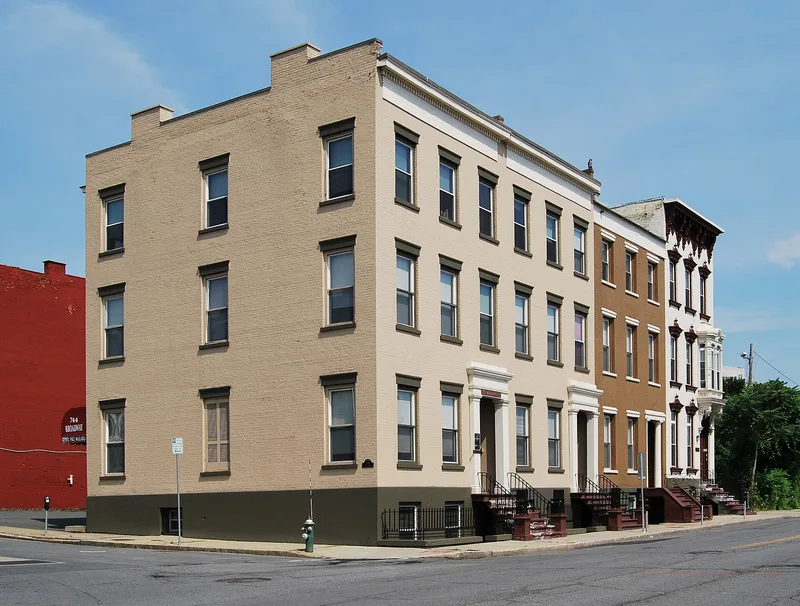
Four brick rowhouses at 744-750 Broadway in Albany survive as an isolated remnant of a once continuous line of townhouses and shops along north Broadway. Each is three stories and three bays wide, with a side-hall plan above a raised basement. Number 748, built about 1830-1833, combines Federal and Greek Revival features, including molded marble trim and a notably intact interior. Numbers 744 and 746, built in 1841 for City Chamberlain Sanford Cobb, are matching Greek Revival houses with sandstone details and wrought-iron stoop railings. Number 750, dating to the early 1870s, is an ornate Italianate house with an oriel window and a bracketed cornice. The houses reflect the prosperity of Albany's upper-middle class as the Erie Canal, the lumber district and the rail lines reshaped the city's north end. Urban renewal demolition has since cleared most of the surrounding blocks, which leaves these four buildings as nearly the only evidence of the area's nineteenth-century residential character.
Machine-generated summary. This summary was generated by a language model from the official nomination document and has not been reviewed line by line by an editor. It may contain errors. Check the source document before relying on any detail. Source: nomination document (PDF) · catalog entry. Generated October 2026 (model claude-sonnet-5-5, prompt v1.0-2026-10-29).
| Period of significance | 1830-1873 |
|---|---|
| Styles | Federal/Greek Revival (748), Greek Revival (744-746), Italianate (750) |
| Areas of significance | Architecture |
| Acreage | 0.9 |
| Boundary source | not published |
| Full listing page | Buildings at 744, 746, 748, 750 Broadway (property record) |
What listing means for this property
This is a historic district. Buildings within its boundary are either contributing (they add to the district's significance) or non-contributing. Owners of contributing income-producing buildings can claim the 20% federal rehabilitation tax credit; homeowners should look at state credits. National Register districts impose no design review by themselves; a local historic district ordinance, if one exists, does (the difference explained).
General information, not legal or tax advice. Rules change; confirm with your State Historic Preservation Office or a qualified adviser.