Buildings at 744, 746, 748, 750 Broadway

Why it's listed
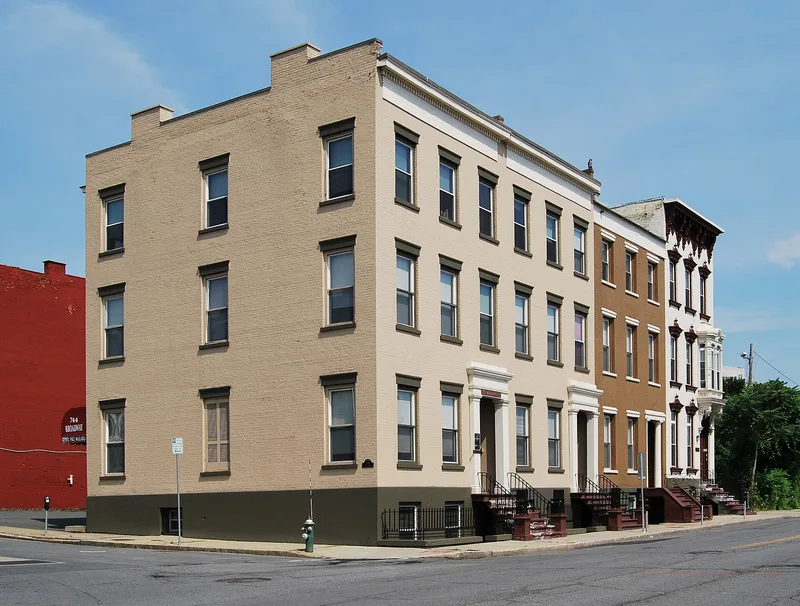
Four brick rowhouses at 744-750 Broadway in Albany survive as an isolated remnant of a once continuous line of townhouses and shops along north Broadway. Each is three stories and three bays wide, with a side-hall plan above a raised basement. Number 748, built about 1830-1833, combines Federal and Greek Revival features, including molded marble trim and a notably intact interior. Numbers 744 and 746, built in 1841 for City Chamberlain Sanford Cobb, are matching Greek Revival houses with sandstone details and wrought-iron stoop railings. Number 750, dating to the early 1870s, is an ornate Italianate house with an oriel window and a bracketed cornice. The houses reflect the prosperity of Albany's upper-middle class as the Erie Canal, the lumber district and the rail lines reshaped the city's north end. Urban renewal demolition has since cleared most of the surrounding blocks, which leaves these four buildings as nearly the only evidence of the area's nineteenth-century residential character.
Significance in brief: The nomination argues the rowhouses are distinctive, well-preserved examples of urban townhouse design in Federal, Greek Revival and Italianate styles. They are rare isolated survivors of what was once a long street of fashionable rowhouses along north Broadway. They also illustrate Albany's nineteenth-century expansion driven by the Erie Canal and the railroads.
Machine-generated summary. This summary was generated by a language model from the official nomination document and has not been reviewed line by line by an editor. It may contain errors. Check the source document before relying on any detail. Source: nomination document (PDF) · National Archives catalog entry. NRHP reference 87002180, listed December 17, 1987. Summary generated October 2026 (model claude-sonnet-5-5, prompt v1.0-2026-10-29, confidence medium).
Key facts
| Address | 744--750 Broadway, Albany |
|---|---|
| County | Albany County |
| Listed | December 17, 1987 |
| Reference number | 87002180 |
| Resource type | District |
| Period of significance | 1830-1873 |
| Architectural style | Federal/Greek Revival (748), Greek Revival (744-746), Italianate (750) |
| Areas of significance | Architecture |
| Level of significance | Local |
| Status (as stated in the nomination) | Condition is marked as deteriorated, altered and good, with the buildings marked both occupied and unoccupied. The surrounding area has been largely cleared by urban renewal demolition. |
| Acreage | 0.9 |
| Coordinates | 42.65635, -73.74853 (NPS GIS) |
What listing means for this property
This is a historic district. Buildings within its boundary are either contributing (they add to the district's significance) or non-contributing. Owners of contributing income-producing buildings can claim the 20% federal rehabilitation tax credit; homeowners should look at state credits. National Register districts impose no design review by themselves; a local historic district ordinance, if one exists, does (the difference explained).
General information, not legal or tax advice. Rules change; confirm with your State Historic Preservation Office or a qualified adviser.
Sources and further reading
- National Park Service, National Register of Historic Places database (snapshot May 2026), reference 87002180.
- Nomination form (PDF, National Archives) — catalog entry
- Wikipedia article (used for cross-checking only; text not reproduced here)
- Wikidata Q922936
- This listing as JSON
Last updated October 2026. Found an error? See the editorial policy for how to report it.