Bronson, Dr. Oliver, House and Stables

The National Park Service has not published a boundary polygon for this district; the map shows the listed properties inside it and the district's reference point.
Why it's listed
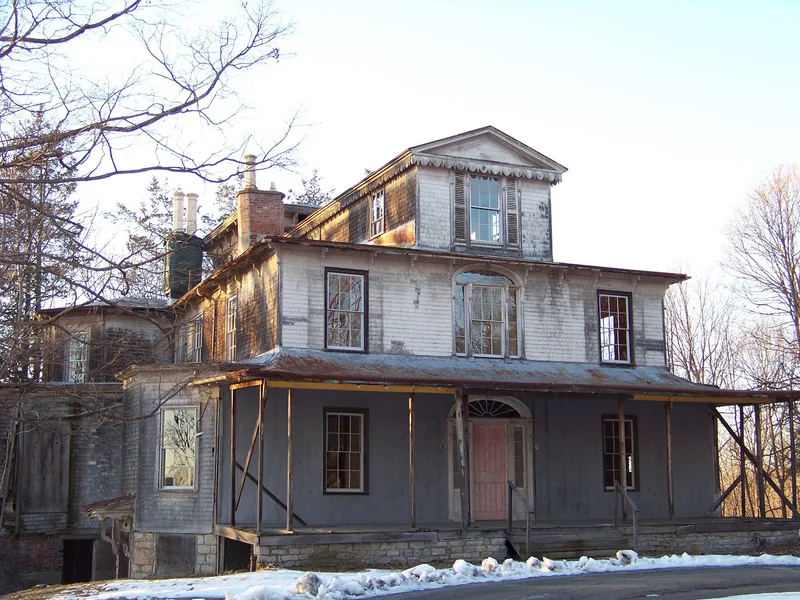
Set on the brow of a steep rise above the Hudson River, this country house in Hudson, New York, looks west toward the Catskill Mountains. It began as an elegant Federal-style dwelling, probably built before 1820 by an unknown builder. Dr. Oliver Bronson bought it in the late 1830s and hired architect Alexander Jackson Davis to remodel it in 1839 and again in 1849. Davis added projecting bracketed eaves, designed a Palladian-form stables south of the house, and later built a west addition with an Italianate tower, octagonal ends and bay windows. The brackets on both buildings are unusual, and the stables are the only Hudson River bracketed-style stables known to be Davis's work. Inside, an elliptical stair spirals through three stories, and the northeast parlor has a notable Federal doorway and mantel. The house later became part of a state training school's grounds and was vacant when nominated, still keeping a largely rural setting.
Machine-generated summary. This summary was generated by a language model from the official nomination document and has not been reviewed line by line by an editor. It may contain errors. Check the source document before relying on any detail. Source: nomination document (PDF) · catalog entry. Generated October 2026 (model claude-sonnet-5-5, prompt v1.0-2026-10-29).
| Period of significance | 19th Century |
|---|---|
| Styles | Federal, with Bracketed and Italianate alterations by Davis |
| Areas of significance | Architecture |
| Boundary source | not published |
| Full listing page | Bronson, Dr. Oliver, House and Stables (property record) |
What listing means for this property
This is a historic district. Buildings within its boundary are either contributing (they add to the district's significance) or non-contributing. Owners of contributing income-producing buildings can claim the 20% federal rehabilitation tax credit; homeowners should look at state credits. National Register districts impose no design review by themselves; a local historic district ordinance, if one exists, does (the difference explained).
Noted as vacant in the nomination. Nomination documents can be decades old; current status may differ. If you are considering buying an empty listed property, read the due-diligence checklist.
General information, not legal or tax advice. Rules change; confirm with your State Historic Preservation Office or a qualified adviser.