Breakabeen Historic District

Why it's listed
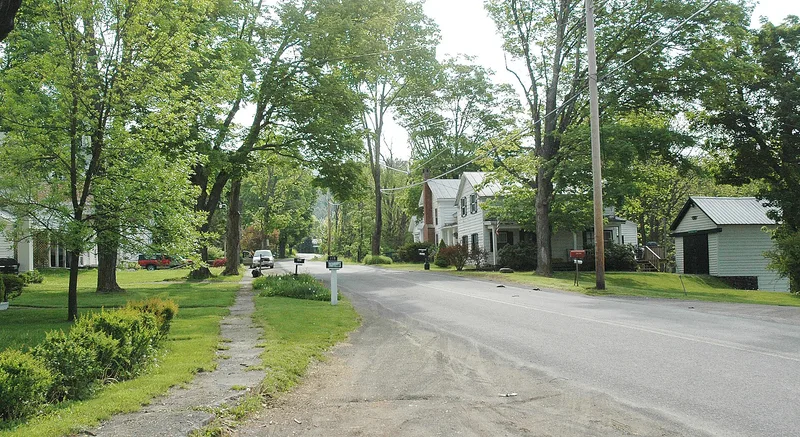
Breakabeen is a small village in central Schoharie County, New York, set on a gentle hillside beside Keyser's Kill and east of Schoharie Creek. About 35 wooden buildings remain, nearly all built before 1870. Settlement began between about 1738 and 1745 with Palatine Germans, and mills made the place a saw and grist milling center. More than half the village went up between 1830 and 1860, mostly in the Greek Revival style as local carpenters interpreted it. Temple-fronted general stores, an insurance office, several dwellings and a church with a bold pediment and three-tiered bell tower show the style. A post-Civil War hotel, later lost to fire, added an Italian villa variation. Growth ended after the Civil War as rail-borne goods and westward migration undercut local business. The district was listed for its uniform scale and style and for preserving a visible record of mid-19th-century life in the Schoharie Valley, free of modern intrusions.
Machine-generated summary. This summary was generated by a language model from the official nomination document and has not been reviewed line by line by an editor. It may contain errors. Check the source document before relying on any detail. Source: nomination document (PDF) · catalog entry. Generated October 2026 (model claude-sonnet-5-5, prompt v1.0-2026-10-29).
| Styles | Greek Revival (folk versions), with a post-Civil War hotel in an Italian villa variation |
|---|---|
| Areas of significance | Exploration/Settlement, Architecture |
| Acreage | 3718 |
| Boundary source | NPS cultural-resource GIS polygon |
| Full listing page | Breakabeen Historic District (property record) |
What listing means for this property
This is a historic district. Buildings within its boundary are either contributing (they add to the district's significance) or non-contributing. Owners of contributing income-producing buildings can claim the 20% federal rehabilitation tax credit; homeowners should look at state credits. National Register districts impose no design review by themselves; a local historic district ordinance, if one exists, does (the difference explained).
General information, not legal or tax advice. Rules change; confirm with your State Historic Preservation Office or a qualified adviser.