Boerum Hill Historic District

Why it's listed
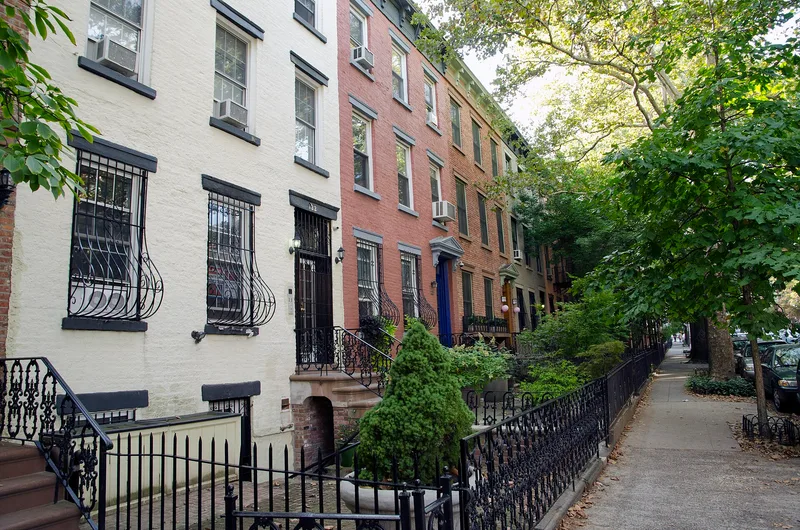
Boerum Hill, in Brooklyn, is a neighborhood of roughly 250 townhouses and a few small commercial buildings erected between 1845 and 1890. The rows sit mainly on four long east-west streets: Pacific, Dean, Bergen and Wyckoff. Most houses are three-story brick buildings with stoops and areaways, built in a late Greek Revival or early Italianate manner, with some Gothic Revival, Second Empire, Neo Grec and Queen Anne examples. Their similar massing and materials give the area an unusually uniform appearance. Many retain original cast and wrought iron railings and entrances. Development began with speculative townhouse construction in the late 1840s, and little substantial building followed after the 1880s. The neighborhood housed local merchants and businessmen, and also some locally prominent residents, including Brooklyn Eagle editor Samuel G. Arnold. It was listed for its architectural quality and as a surviving example of mid-nineteenth century middle-class urban housing. Only twelve of nearly 250 buildings are considered intrusions.
Machine-generated summary. This summary was generated by a language model from the official nomination document and has not been reviewed line by line by an editor. It may contain errors. Check the source document before relying on any detail. Source: nomination document (PDF) · catalog entry. Generated October 2026 (model claude-sonnet-5-5, prompt v1.0-2026-10-29).
| Period of significance | c1840 - c1890 |
|---|---|
| Styles | Greek Revival, Italianate, with Gothic Revival, French Second Empire, Neo Grec and Queen Anne examples |
| Areas of significance | Architecture |
| Acreage | 20 |
| Boundary source | NPS cultural-resource GIS polygon |
| Full listing page | Boerum Hill Historic District (property record) |
What listing means for this property
This is a historic district. Buildings within its boundary are either contributing (they add to the district's significance) or non-contributing. Owners of contributing income-producing buildings can claim the 20% federal rehabilitation tax credit; homeowners should look at state credits. National Register districts impose no design review by themselves; a local historic district ordinance, if one exists, does (the difference explained).
General information, not legal or tax advice. Rules change; confirm with your State Historic Preservation Office or a qualified adviser.