Audubon Terrace Historic District

The National Park Service has not published a boundary polygon for this district; the map shows the listed properties inside it and the district's reference point.
Why it's listed
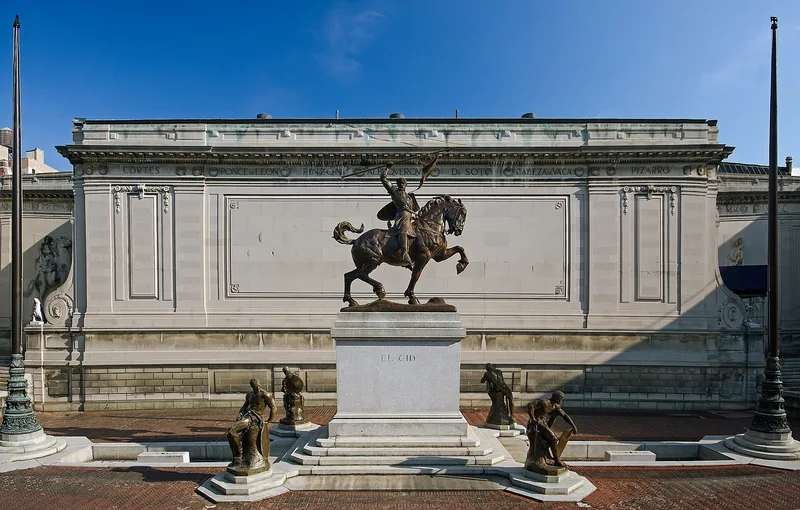
Audubon Terrace is a cluster of eight cultural and scholarly buildings gathered around a terraced courtyard in Washington Heights, Manhattan, on land once part of John James Audubon's estate. Philanthropist Archer M. Huntington began assembling the site in 1904, starting with the Hispanic Society of America, and his cousin Charles P. Huntington designed most of the buildings in a unified neo-Italian Renaissance style. Institutions housed here include the American Numismatic Society, the American Geographical Society, the Museum of the American Indian, the Church of Our Lady of Esperanza, and the American Academy and Institute of Arts and Letters, whose two buildings were designed by William Mitchell Kendall of McKim, Mead & White and by Cass Gilbert. Sculpture by Anna Hyatt Huntington and others adds to the Beaux-Arts composition. The complex was recognized because gathering research institutions outside a university setting was unusual in America, because it offered scholarly facilities free to the public, and because its design remains unified and its collections are nationally important.
Machine-generated summary. This summary was generated by a language model from the official nomination document and has not been reviewed line by line by an editor. It may contain errors. Check the source document before relying on any detail. Source: nomination document (PDF) · catalog entry. Generated October 2026 (model claude-sonnet-5-5, prompt v1.0-2026-10-29).
| Period of significance | 1907-1930 |
|---|---|
| Styles | Neo-Italian Renaissance (neo-Renaissance), Beaux-Arts planning |
| Areas of significance | Community Planning and Development, Education, Architecture |
| Acreage | 2.9 |
| Boundary source | not published |
| Full listing page | Audubon Terrace Historic District (property record) |
What listing means for this property
This is a historic district. Buildings within its boundary are either contributing (they add to the district's significance) or non-contributing. Owners of contributing income-producing buildings can claim the 20% federal rehabilitation tax credit; homeowners should look at state credits. National Register districts impose no design review by themselves; a local historic district ordinance, if one exists, does (the difference explained).
General information, not legal or tax advice. Rules change; confirm with your State Historic Preservation Office or a qualified adviser.