Alfred Village Historic District

Why it's listed
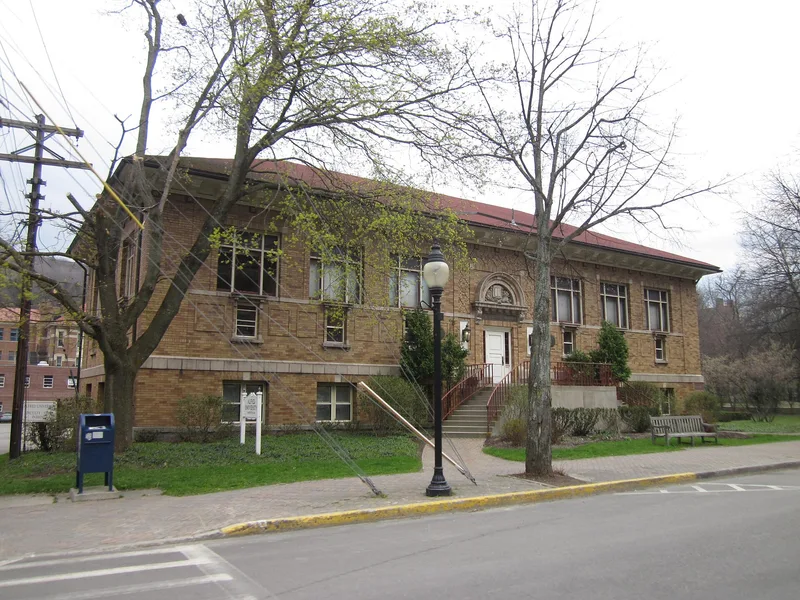
Alfred Village Historic District covers the historic core of a small village in rural Allegany County, New York. It sits in the narrow valley between the campuses of Alfred University, the S.U.N.Y. College of Ceramics and the S.U.N.Y. College of Agriculture and Technology. The district includes 133 properties along Main Street and parts of Church, Ford, Glenn, Park, Sayles, Terrace and West University Streets. Buildings range from the Federal style Century House of about 1818, the village's oldest structure, to early twentieth century Colonial Revival and Neoclassical designs. Nearly one hundred are residences, alongside commercial blocks, a school, a library, a firehouse and a church. Carnegie Hall, a Beaux-Arts library, and a one-acre village green form the focal point. The district's defining feature is terra-cotta, used for red tile roofs and decorative trim, which unifies a varied collection of buildings. The boundary was drawn to include only the most intact and architecturally significant structures.
Machine-generated summary. This summary was generated by a language model from the official nomination document and has not been reviewed line by line by an editor. It may contain errors. Check the source document before relying on any detail. Source: nomination document (PDF) · catalog entry. Generated October 2026 (model claude-sonnet-5-5, prompt v1.0-2026-10-29).
| Styles | Mixed styles including Federal, Greek Revival, Gothic Revival, Octagon, Italianate, Italian Villa, Queen Anne/Eastlake, Romanesque Revival, Colonial Revival, Neoclassical and Beaux-Arts |
|---|---|
| Areas of significance | Education, Architecture, Religion |
| Acreage | 55 |
| Boundary source | NPS cultural-resource GIS polygon |
| Full listing page | Alfred Village Historic District (property record) |
What listing means for this property
This is a historic district. Buildings within its boundary are either contributing (they add to the district's significance) or non-contributing. Owners of contributing income-producing buildings can claim the 20% federal rehabilitation tax credit; homeowners should look at state credits. National Register districts impose no design review by themselves; a local historic district ordinance, if one exists, does (the difference explained).
General information, not legal or tax advice. Rules change; confirm with your State Historic Preservation Office or a qualified adviser.