Woodland Street Historic District

The National Park Service has not published a boundary polygon for this district; the map shows the listed properties inside it and the district's reference point.
Why it's listed
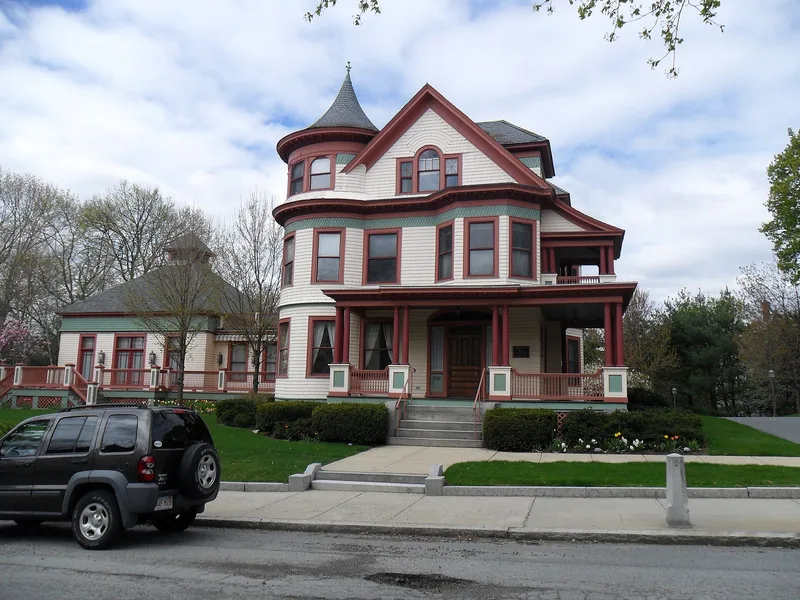
Woodland Street in Worcester holds a district of 19 buildings, mostly houses, built between about 1868 and 1904. Development began in the late 1860s, when seven houses, most on double lots, went up on the west side of the street between 1868 and 1881. These include Second Empire and Victorian Gothic designs. The John Hill House of 1876 has an unusual L-shaped plan, with its entry set at a 45-degree angle where the two wings meet. By the 1890s the street was surrounded by residential neighborhoods, and rising land values led to denser building. Older double lots were subdivided and new Queen Anne and Colonial Revival houses were added, along with All Souls' Universalist Church of about 1891. The Frank Heath House of about 1904 is a fine Colonial Revival example with Palladian windows and Ionic porches. The district was selected because it keeps a largely unaltered section of Victorian housing that shows how the street grew over several decades. Today the buildings are in residential and university use.
Machine-generated summary. This summary was generated by a language model from the official nomination document and has not been reviewed line by line by an editor. It may contain errors. Check the source document before relying on any detail. Source: nomination document (PDF) · catalog entry. Generated October 2026 (model claude-sonnet-5-5, prompt v1.0-2026-10-29).
| Styles | Mixed Victorian: Second Empire, Victorian Gothic, Queen Anne, Italianate and Colonial Revival |
|---|---|
| Areas of significance | Community Planning and Development, Architecture |
| Acreage | 3 |
| Boundary source | not published |
| Full listing page | Woodland Street Historic District (property record) |
What listing means for this property
This is a historic district. Buildings within its boundary are either contributing (they add to the district's significance) or non-contributing. Owners of contributing income-producing buildings can claim the 20% federal rehabilitation tax credit; homeowners should look at state credits. National Register districts impose no design review by themselves; a local historic district ordinance, if one exists, does (the difference explained).
General information, not legal or tax advice. Rules change; confirm with your State Historic Preservation Office or a qualified adviser.