Whitinsville Historic District

Why it's listed
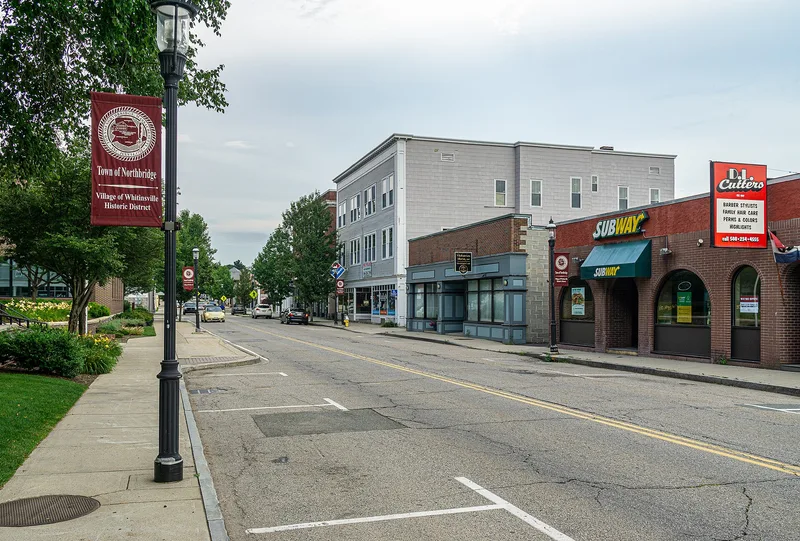
Whitinsville is a mill village in the southern part of Northbridge, Massachusetts, set in a valley along the Mumford River between two large mill ponds. The district holds about 350 structures on some 250 acres, with six main roads converging on the valley. Its industrial core includes the 1826 Brick Mill, the 1845 Whitinsville Cotton Mills and the vast Whitin Machine Works, which at its peak had nearly 1.75 million square feet of floor space. Around Memorial Square stand a town hall, savings bank, library, gymnasium, schools and three churches, mostly gifts from the Whitin and Lasell families and designed by prominent Boston and Worcester architects. Surrounding streets hold housing for every level of the workforce, from owners' mansions to foremen's cottages and laborers' tenements, including 17 Greek Revival duplexes on Forest Street and a group of 1920s company-built houses. Together they illustrate how a single industrial community developed over about a century.
Machine-generated summary. This summary was generated by a language model from the official nomination document and has not been reviewed line by line by an editor. It may contain errors. Check the source document before relying on any detail. Source: nomination document (PDF) · catalog entry. Generated October 2026 (model claude-sonnet-5-5, prompt v1.0-2026-10-29).
| Styles | Mixed: Federal, Greek Revival, Italianate, Gothic Revival, Lombard and Richardsonian Romanesque, Stick, Queen Anne, Colonial Revival, Neo-Classical, American Colonial |
|---|---|
| Areas of significance | Industry, Architecture, Social History |
| Acreage | 250 |
| Boundary source | NPS cultural-resource GIS polygon |
| Full listing page | Whitinsville Historic District (property record) |
What listing means for this property
This is a historic district. Buildings within its boundary are either contributing (they add to the district's significance) or non-contributing. Owners of contributing income-producing buildings can claim the 20% federal rehabilitation tax credit; homeowners should look at state credits. National Register districts impose no design review by themselves; a local historic district ordinance, if one exists, does (the difference explained).
General information, not legal or tax advice. Rules change; confirm with your State Historic Preservation Office or a qualified adviser.