Wellington Street Apartment House District

The National Park Service has not published a boundary polygon for this district; the map shows the listed properties inside it and the district's reference point.
Why it's listed
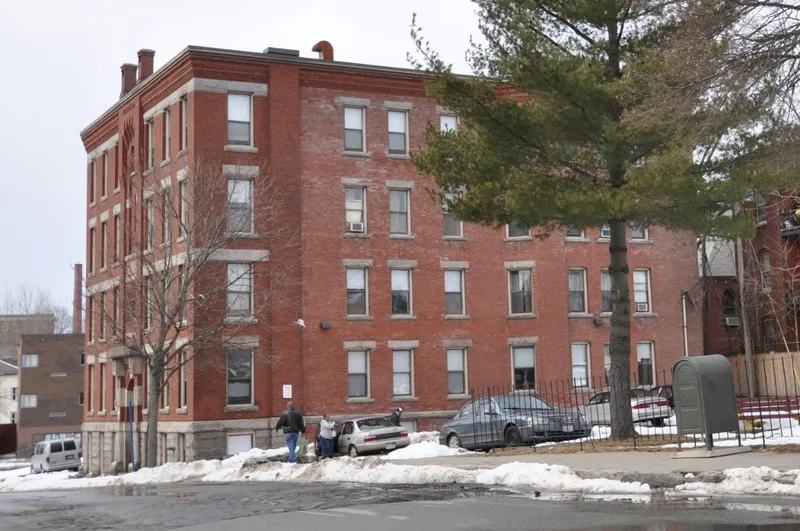
This group of brick apartment houses stands on Wellington Street, Irving Street and Jaques Avenue in Worcester. Most were built between 1885 and 1901 and form the densest surviving remnant of a larger apartment district that once stretched from Main Street South to Chandler Street. Wellington Street was largely undeveloped until Thomas J. Barrett built a two-storey Queen Anne brick house there in 1885. Three- and four-storey owner-occupied apartment houses followed, sharing floor plans with the city's three-deckers and decorated with sandstone trim, arched entries and brickwork. From 1892, with the Columbia, larger buildings on the scale of those on Main Street were put up by builder-developers as income properties. These include the Knowlton and the Florence. The district also contains the First Freewill Baptist Church, a Gothic-style brick and granite building from 1888 designed by George Adams, with its original slate, stained glass and terracotta tiles. An 1851 Greek Revival house survives as well.
Machine-generated summary. This summary was generated by a language model from the official nomination document and has not been reviewed line by line by an editor. It may contain errors. Check the source document before relying on any detail. Source: nomination document (PDF) · catalog entry. Generated October 2026 (model claude-sonnet-5-5, prompt v1.0-2026-10-29).
| Period of significance | 1885-1901 |
|---|---|
| Styles | Primarily Romanesque Revival, with astylistic Victorian, Queen Anne, Gothic and Greek Revival buildings |
| Areas of significance | Architecture |
| Acreage | 2 |
| Boundary source | not published |
| Full listing page | Wellington Street Apartment House District (property record) |
What listing means for this property
This is a historic district. Buildings within its boundary are either contributing (they add to the district's significance) or non-contributing. Owners of contributing income-producing buildings can claim the 20% federal rehabilitation tax credit; homeowners should look at state credits. National Register districts impose no design review by themselves; a local historic district ordinance, if one exists, does (the difference explained).
General information, not legal or tax advice. Rules change; confirm with your State Historic Preservation Office or a qualified adviser.