Washington Square Historic District

Why it's listed
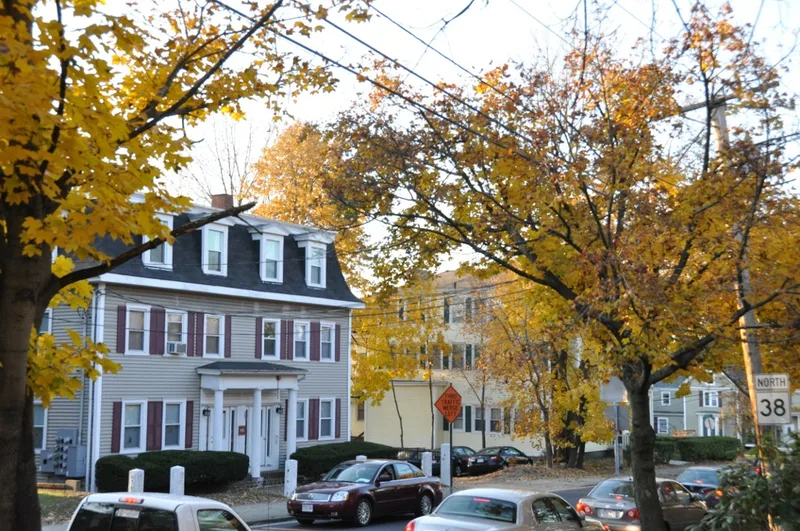
Washington Square Historic District is a neighborhood of 67 buildings on the west slope of Belvidere Hill, less than a mile from central Lowell, Massachusetts. Its boundaries follow an 1832 subdivision plan commissioned by brothers John and Thomas Nesmith and designed by landscape architect Alexander Wadsworth, who laid out tree-lined perpendicular streets and a small trapezoidal park. Nesmith Street, 60 feet wide, was the city's first boulevard. Most houses were built in the 1840s and 1850s. The majority are Italianate, the earliest examples of that style in Lowell, alongside Federal, Greek Revival, Second Empire, Stick and Queen Anne buildings. The John Nesmith House, built between 1841 and 1843, is a Greek Revival and Regency mansion. The neighborhood drew mill owners, agents, merchants and other prominent residents, making it the city's earliest fashionable address. The park was privately held until the city bought it in 1860. Many houses have been subdivided, but exteriors remain largely intact.
Machine-generated summary. This summary was generated by a language model from the official nomination document and has not been reviewed line by line by an editor. It may contain errors. Check the source document before relying on any detail. Source: nomination document (PDF) · catalog entry. Generated October 2026 (model claude-sonnet-5-5, prompt v1.0-2026-10-29).
| Period of significance | 1800-1899 (specific dates 1831-32) |
|---|---|
| Styles | Federal, Greek Revival, Italianate, Regency, Second Empire, Stick and Queen Anne |
| Areas of significance | Community Planning and Development, Architecture |
| Acreage | 16.5 |
| Boundary source | NPS cultural-resource GIS polygon |
| Full listing page | Washington Square Historic District (property record) |
What listing means for this property
This is a historic district. Buildings within its boundary are either contributing (they add to the district's significance) or non-contributing. Owners of contributing income-producing buildings can claim the 20% federal rehabilitation tax credit; homeowners should look at state credits. National Register districts impose no design review by themselves; a local historic district ordinance, if one exists, does (the difference explained).
General information, not legal or tax advice. Rules change; confirm with your State Historic Preservation Office or a qualified adviser.