Wamsutta Mills

Why it's listed
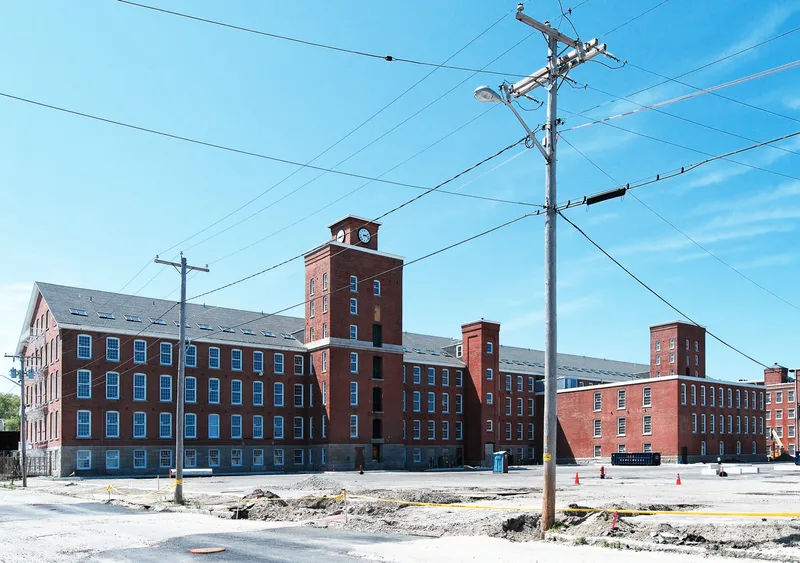
Wamsutta Mills is a nineteen-acre textile complex in New Bedford's Logan-Hicks area, developed from 1847 over about 75 years as the business grew. A fire in 1924 destroyed the earliest four-story Mills Nos. 1, 2 and 3, but a group of two- to four-story brick and stone mills survives, along with picker houses, a weave shed, a cloth and harness room and a mill pond. The buildings are utilitarian, with large regularly spaced windows for daylight, brick corbelling, granite sills and wrought-iron fire escapes with scrolled brackets. Mills Nos. 4, 5 and 6 form a nearly 1,000-foot facade along Acushnet Avenue. The company was among the city's largest employers, with 2,200 operatives by 1891. After 1918 its president spent $2,500,000 on modernization, shifted from steam to electric power, ran market surveys and advertised directly to consumers. Several mill buildings are being converted to apartments.
Machine-generated summary. This summary was generated by a language model from the official nomination document and has not been reviewed line by line by an editor. It may contain errors. Check the source document before relying on any detail. Source: nomination document (PDF) · catalog entry. Generated October 2026 (model claude-sonnet-5-5, prompt v1.0-2026-10-29).
| Styles | Other: Utilitarian industrial |
|---|---|
| Areas of significance | Commerce, Community Planning and Development, Industry, Invention |
| Acreage | 19.3 |
| Boundary source | NPS cultural-resource GIS polygon |
| Full listing page | Wamsutta Mills (property record) |
What listing means for this property
This is a historic district. Buildings within its boundary are either contributing (they add to the district's significance) or non-contributing. Owners of contributing income-producing buildings can claim the 20% federal rehabilitation tax credit; homeowners should look at state credits. National Register districts impose no design review by themselves; a local historic district ordinance, if one exists, does (the difference explained).
General information, not legal or tax advice. Rules change; confirm with your State Historic Preservation Office or a qualified adviser.