Wachusett Dam Historic District

Why it's listed
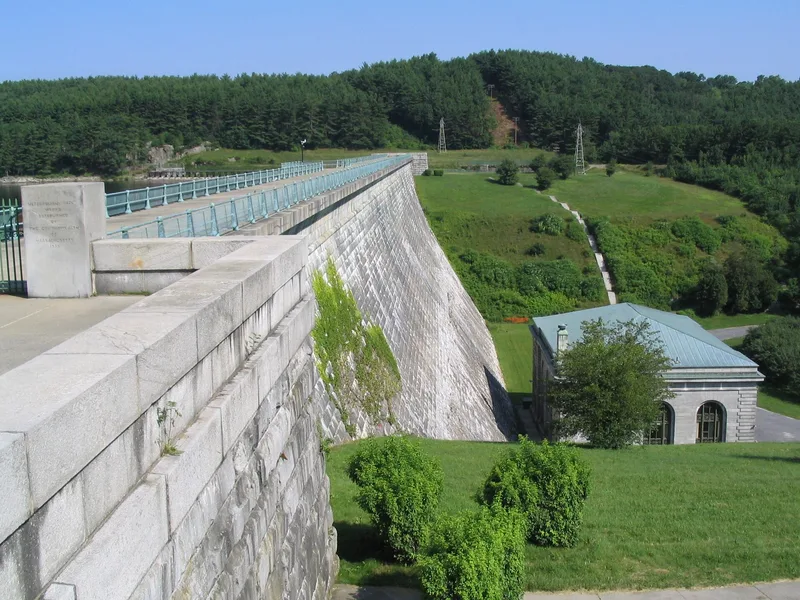
Wachusett Dam and its surrounding structures sit in the narrow gorge at the mouth of Wachusett Reservoir in Clinton, Massachusetts. The district includes an 850-foot gravity spillway with a 450-foot waste weir, two granite-faced concrete arch bridges, a symmetrical granite gatehouse and powerhouse, and a concrete lightning arrester chamber. Work on the dam began in 1900 and finished in 1906, as part of the third stage of Boston's metropolitan water supply. Engineers of the Metropolitan Water Board designed it under Frederic P. Stearns. Shepley, Rutan & Coolidge designed the powerhouse, and Arthur Shurcliff of Olmsted & Olmsted shaped the landscape. The rustic bridges and the rough-cut waste channel contrast with the formal powerhouse, circular pool and mulberry trees. In August 1911, power transmitted from the site became the first known hydroelectric generation from a domestic water supply. The district was listed for its association with the water system's development and for its design quality.
Machine-generated summary. This summary was generated by a language model from the official nomination document and has not been reviewed line by line by an editor. It may contain errors. Check the source document before relying on any detail. Source: nomination document (PDF) · catalog entry. Generated October 2026 (model claude-sonnet-5-5, prompt v1.0-2026-10-29).
| Period of significance | 1897-1926 |
|---|---|
| Styles | Neoclassical (lower gatehouse/powerhouse); naturalistic Olmsted-influenced landscape with rustic granite-faced bridges |
| Areas of significance | Community Planning and Development, Engineering, Politics/Government, Architecture |
| Acreage | 54 |
| Boundary source | NPS cultural-resource GIS polygon |
| Full listing page | Wachusett Dam Historic District (property record) |
What listing means for this property
This is a historic district. Buildings within its boundary are either contributing (they add to the district's significance) or non-contributing. Owners of contributing income-producing buildings can claim the 20% federal rehabilitation tax credit; homeowners should look at state credits. National Register districts impose no design review by themselves; a local historic district ordinance, if one exists, does (the difference explained).
General information, not legal or tax advice. Rules change; confirm with your State Historic Preservation Office or a qualified adviser.