Turner Falls Historic District

Why it's listed
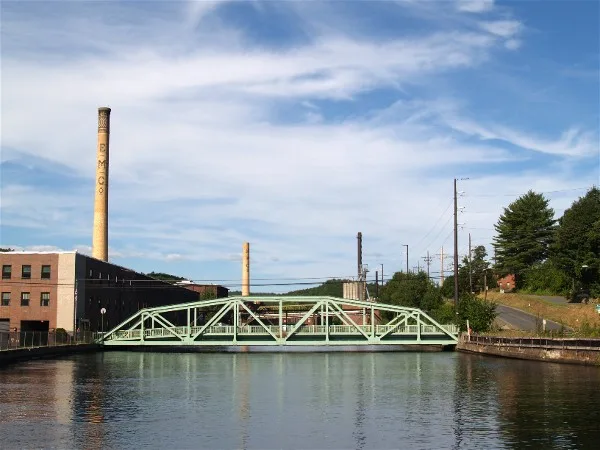
Turners Falls is a planned mill village on a knoll beside the Connecticut River in Montague, Massachusetts. Its roughly 130 acres hold more than 275 properties, mostly built between 1866 and 1886 under Alvah Crocker's concept of an industrial community. A 1867 plan by William P. Crocker and Charles W. Hazelton placed mill sites along a power canal fed by a dam, with the rest of the village on a grid of lettered avenues and numbered streets. Avenue A was laid out as a 100-foot tree-lined avenue. The district includes brick paper mills, a cotton mill, the concrete dam of 1912-15, canal bridges, churches, commercial blocks, and many single and multi-family homes. Industries such as the Keith Paper Company, the Montague Paper Company, the cutlery works and the Turners Falls Company shaped its economy and drew immigrant workers. The district is notable because most of the original buildings survive and few modern intrusions disturb its character.
Machine-generated summary. This summary was generated by a language model from the official nomination document and has not been reviewed line by line by an editor. It may contain errors. Check the source document before relying on any detail. Source: nomination document (PDF) · catalog entry. Generated October 2026 (model claude-sonnet-5-5, prompt v1.0-2026-10-29).
| Styles | Late nineteenth century vernacular |
|---|---|
| Areas of significance | Industry, Community Planning and Development, Commerce, Historic - Non-Aboriginal, Engineering, Architecture, Social History |
| Acreage | 130 |
| Boundary source | NPS cultural-resource GIS polygon |
| Full listing page | Turner Falls Historic District (property record) |
What listing means for this property
This is a historic district. Buildings within its boundary are either contributing (they add to the district's significance) or non-contributing. Owners of contributing income-producing buildings can claim the 20% federal rehabilitation tax credit; homeowners should look at state credits. National Register districts impose no design review by themselves; a local historic district ordinance, if one exists, does (the difference explained).
General information, not legal or tax advice. Rules change; confirm with your State Historic Preservation Office or a qualified adviser.