Tewksbury State Hospital

Why it's listed
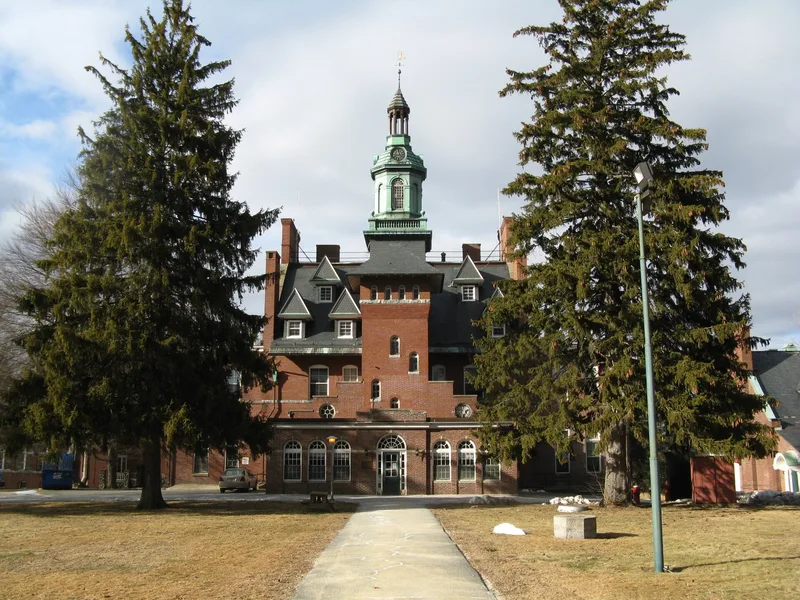
Tewksbury State Hospital occupies a campus on East Street in Tewksbury, Massachusetts, that began as one of three state almshouses opened in 1854. The almshouse was created after a wave of Irish immigration overwhelmed town poorhouses, and it admitted more than 2,000 paupers in its first year. Its original wooden buildings were later replaced. Around 1900 the site was enlarged and converted into a hospital and infirmary. Most surviving buildings date from the early twentieth century, including the 1894 Queen Anne Administration Building and the 1901 Male Asylum, both designed by Boston architect John A. Fox. Red brick walls, fieldstone foundations and slate roofs unify the varied styles. The grounds keep the nineteenth-century almshouse quadrangle, fieldstone pools, mature trees, farm fields and woodland. The district was listed for its architecture, landscape and role in the state's care of the poor and mentally ill. Later parking lots and the 1962 Saunders Building detract in places.
Machine-generated summary. This summary was generated by a language model from the official nomination document and has not been reviewed line by line by an editor. It may contain errors. Check the source document before relying on any detail. Source: nomination document (PDF) · catalog entry. Generated October 2026 (model claude-sonnet-5-5, prompt v1.0-2026-10-29).
| Styles | Late Victorian (Queen Anne, Romanesque); Late 19th & 20th Century Revivals (Colonial, Classical, Tudor); Craftsman; Federal |
|---|---|
| Areas of significance | Health/Medicine, Architecture, Social History, Agriculture |
| Acreage | 800 |
| Boundary source | NPS cultural-resource GIS polygon |
| Full listing page | Tewksbury State Hospital (property record) |
What listing means for this property
This is a historic district. Buildings within its boundary are either contributing (they add to the district's significance) or non-contributing. Owners of contributing income-producing buildings can claim the 20% federal rehabilitation tax credit; homeowners should look at state credits. National Register districts impose no design review by themselves; a local historic district ordinance, if one exists, does (the difference explained).
General information, not legal or tax advice. Rules change; confirm with your State Historic Preservation Office or a qualified adviser.