State Lunatic Hospital at Danvers

Why it's listed
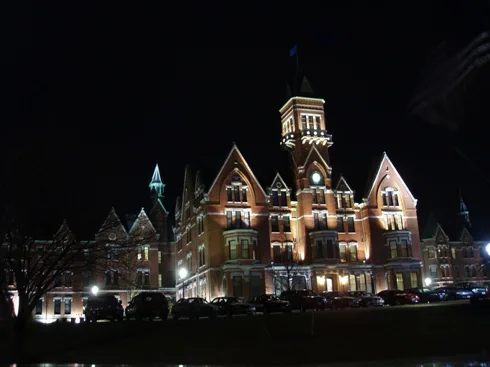
Danvers State Hospital is a large mental health campus on Hathorne Hill in Danvers, Massachusetts. Construction began in 1874 on a site of more than 500 acres with long views toward Boston. Its centerpiece is the Kirkbride Complex, a red brick building with granite trim and steep slate roofs, designed in the Victorian Gothic style by Boston architect Nathaniel J. Bradlee. It follows the planning ideas of Dr. Thomas S. Kirkbride, with a central administration block flanked by stepped-back wings separating men and women, and the most excited patients in the outer wings. Fireproof passages and ventilating towers were part of the design. The project was controversial for its ornament and its final cost of about $1.46 million. Later buildings include nurses' homes, tubercular treatment buildings, a medical building, staff cottages, repair shops and farm structures. Together they show how the hospital moved toward specialized care, occupational therapy and greater self-sufficiency. The nominated area covers the Kirkbride hilltop and the Maple Street service and cottage area.
Machine-generated summary. This summary was generated by a language model from the official nomination document and has not been reviewed line by line by an editor. It may contain errors. Check the source document before relying on any detail. Source: nomination document (PDF) · catalog entry. Generated October 2026 (model claude-sonnet-5-5, prompt v1.0-2026-10-29).
| Styles | Victorian Gothic (Kirkbride Complex); also Queen Anne, Colonial Revival, Greek Revival and Beaux Arts elements in later buildings |
|---|---|
| Areas of significance | Agriculture, Health/Medicine, Education, Architecture, Social History |
| Acreage | 178 |
| Boundary source | NPS cultural-resource GIS polygon |
| Full listing page | State Lunatic Hospital at Danvers (property record) |
What listing means for this property
This is a historic district. Buildings within its boundary are either contributing (they add to the district's significance) or non-contributing. Owners of contributing income-producing buildings can claim the 20% federal rehabilitation tax credit; homeowners should look at state credits. National Register districts impose no design review by themselves; a local historic district ordinance, if one exists, does (the difference explained).
General information, not legal or tax advice. Rules change; confirm with your State Historic Preservation Office or a qualified adviser.