St. Joseph's Roman Catholic Church Complex

The National Park Service has not published a boundary polygon for this district; the map shows the listed properties inside it and the district's reference point.
Why it's listed
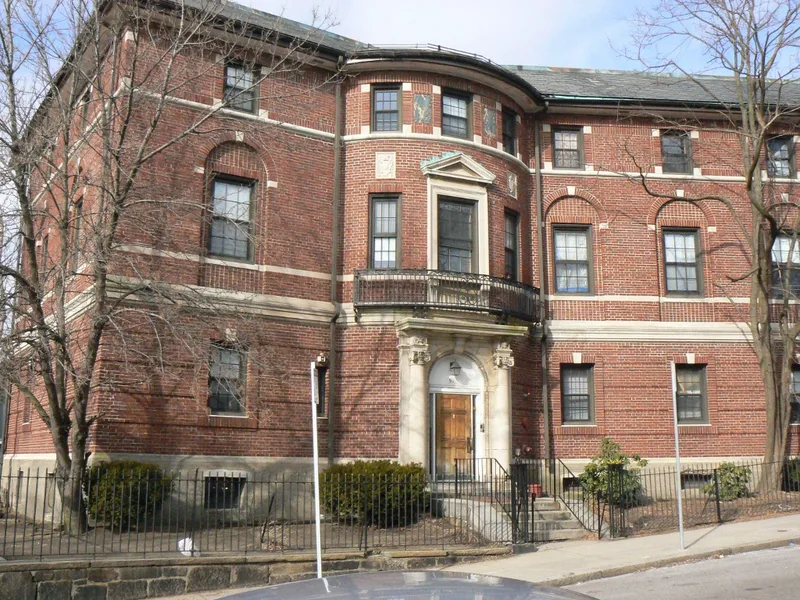
Four red brick buildings grouped around an ornamental green make up this church complex on the rocky southwest slope of Mt. Warren in Roxbury, Boston. The church was built in 1845-46 and is the first Roman Catholic church in Roxbury, founded as Irish immigration swelled the area's Catholic population under Bishop Benedict Fenwick. Its design mixes Romanesque Revival and Italianate elements, with round-arched openings and a tall bell tower. The church was enlarged in 1860, and architect Patrick C. Keeley later remodelled the interior in 1883-1886 and designed the 1886 rectory and the 1887 Mansard-roofed school. A Georgian Revival convent by Charles R. Greco followed in 1916-1917. The interior keeps walnut pews, a gilt-edged paneled ceiling and stained glass by the Mayer Studios of Munich. The complex was found significant for its architecture and its place in Roxbury's Catholic community.
Machine-generated summary. This summary was generated by a language model from the official nomination document and has not been reviewed line by line by an editor. It may contain errors. Check the source document before relying on any detail. Source: nomination document (PDF) · catalog entry. Generated October 2026 (model claude-sonnet-5-5, prompt v1.0-2026-10-29).
| Period of significance | 1845-1917 |
|---|---|
| Styles | Late Victorian: Second Empire, Romanesque Revival; Late 19th/early 20th Century Revival: Georgian Revival |
| Areas of significance | Architecture, Religion |
| Acreage | 1.5 |
| Boundary source | not published |
| Full listing page | St. Joseph's Roman Catholic Church Complex (property record) |
What listing means for this property
This is a historic district. Buildings within its boundary are either contributing (they add to the district's significance) or non-contributing. Owners of contributing income-producing buildings can claim the 20% federal rehabilitation tax credit; homeowners should look at state credits. National Register districts impose no design review by themselves; a local historic district ordinance, if one exists, does (the difference explained).
General information, not legal or tax advice. Rules change; confirm with your State Historic Preservation Office or a qualified adviser.