Shady Hill Historic District

Why it's listed
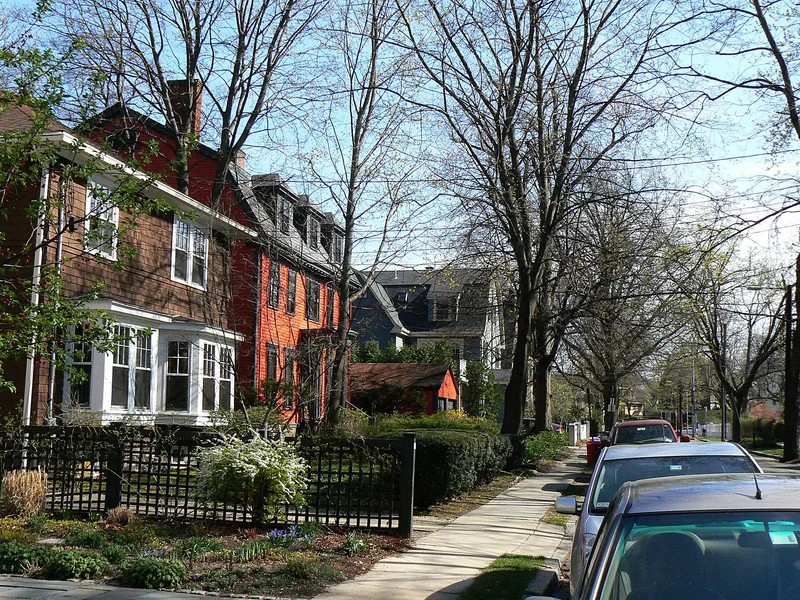
Shady Hill is a tree-lined residential district of roughly 26 acres in Cambridge, Massachusetts, a few blocks from Harvard Square. Land that once belonged to the Frost and Norton estates was subdivided in the 1880s under a curvilinear street plan by Charles Eliot of the Olmsted firm. Deed restrictions required substantial single-family houses set well back from the street. The first houses went up in 1889, and the neighborhood was largely built within about twenty years, with Colonial Revival construction continuing into the 1920s and 1930s. The result is a notably uniform grouping of Queen Anne and Colonial Revival homes, alongside a few earlier houses on Kirkland Street. The district also has strong ties to Harvard. It includes the William James House, the childhood home of poet e. e. cummings, and the Charles W. Eliot House, built for the future Harvard president's family. Its architecture, landscape design and associations with prominent residents support its listing.
Machine-generated summary. This summary was generated by a language model from the official nomination document and has not been reviewed line by line by an editor. It may contain errors. Check the source document before relying on any detail. Source: nomination document (PDF) · catalog entry. Generated October 2026 (model claude-sonnet-5-5, prompt v1.0-2026-10-29).
| Period of significance | 1889-1936 |
|---|---|
| Styles | Queen Anne and Colonial Revival, with some Mansard, Greek Revival and Craftsman examples |
| Areas of significance | Community Planning and Development, Education, Architecture |
| Acreage | 26.5 |
| Boundary source | NPS cultural-resource GIS polygon |
| Full listing page | Shady Hill Historic District (property record) |
What listing means for this property
This is a historic district. Buildings within its boundary are either contributing (they add to the district's significance) or non-contributing. Owners of contributing income-producing buildings can claim the 20% federal rehabilitation tax credit; homeowners should look at state credits. National Register districts impose no design review by themselves; a local historic district ordinance, if one exists, does (the difference explained).
General information, not legal or tax advice. Rules change; confirm with your State Historic Preservation Office or a qualified adviser.