Richmond Court

The National Park Service has not published a boundary polygon for this district; the map shows the listed properties inside it and the district's reference point.
Why it's listed
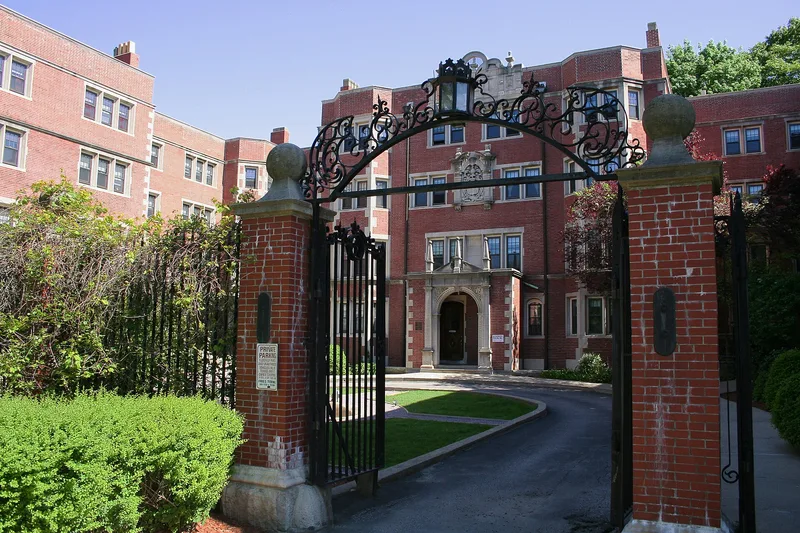
Richmond Court is a four-story red brick apartment complex on Beacon Street in Brookline, built in 1896-1898 to designs by Boston architect Ralph Adams Cram. Five attached sections, each with its own entry, surround a U-shaped courtyard laid out as a small formal park with a fountain topped by a bronze nymph by sculptor Lee Lawrie. Sandstone quoins, belt courses and carved entries decorate the brick walls. The courtyard gave each apartment more windows, better light and air, and a quiet view away from the street. Local sources credit it as the first Boston-area apartment house in the Jacobethan style and the first arranged around a courtyard, and it became a model for later upscale apartment buildings. Cram himself lived there from 1903. It was built by a trust whose trustees included financier Noah W. Jordan, and early residents included architects, lawyers and publishers. The building has since been rehabilitated and remains in rental use.
Machine-generated summary. This summary was generated by a language model from the official nomination document and has not been reviewed line by line by an editor. It may contain errors. Check the source document before relying on any detail. Source: nomination document (PDF) · catalog entry. Generated October 2026 (model claude-sonnet-5-5, prompt v1.0-2026-10-29).
| Period of significance | 1896-98 |
|---|---|
| Styles | Jacobethan (English manor style) |
| Areas of significance | Community Planning and Development, Landscape Architecture, Architecture |
| Acreage | 0.7 |
| Boundary source | not published |
| Full listing page | Richmond Court (property record) |
What listing means for this property
This is a historic district. Buildings within its boundary are either contributing (they add to the district's significance) or non-contributing. Owners of contributing income-producing buildings can claim the 20% federal rehabilitation tax credit; homeowners should look at state credits. National Register districts impose no design review by themselves; a local historic district ordinance, if one exists, does (the difference explained).
General information, not legal or tax advice. Rules change; confirm with your State Historic Preservation Office or a qualified adviser.