Quincy Shore Drive

Why it's listed
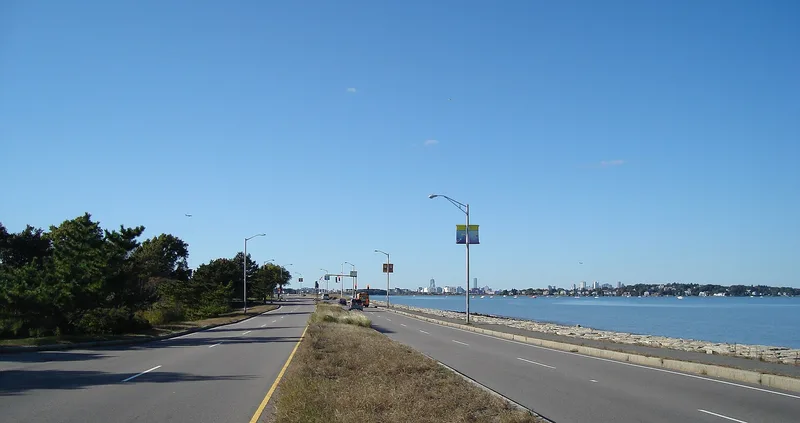
Quincy Shore Drive is a four-mile parkway along the shore of Quincy Bay, one of eight ocean parkways in Boston's metropolitan park system. It has three segments: two tree-lined residential connectors and a central shoreline stretch with views toward Boston and the harbor islands. Planning followed arguments that public ownership of the shoreline would protect access and keep the coast free of encroachment. The Metropolitan Park Commission acquired most of the land by 1900 and began construction in 1903. Early work included a roadway and piers for two yacht clubs. Later work added a concrete bridge over Blacks Creek in 1915-1916 and tide gates installed in 1911, which controlled water flow into the adjacent marshes. Contributing features include the bridge, tide gates, dam, medians and tree plantings. Later additions such as wing walls built in 1963 are not counted. The parkway is listed as a district for its role in providing public shoreline access.
Machine-generated summary. This summary was generated by a language model from the official nomination document and has not been reviewed line by line by an editor. It may contain errors. Check the source document before relying on any detail. Source: nomination document (PDF) · catalog entry. Generated October 2026 (model claude-sonnet-5-5, prompt v1.0-2026-10-29).
| Areas of significance | Community Planning and Development, Conservation, Engineering, Entertainment/Recreation, Landscape Architecture, Transportation |
|---|---|
| Acreage | 23 |
| Boundary source | NPS cultural-resource GIS polygon |
| Full listing page | Quincy Shore Drive (property record) |
What listing means for this property
This is a historic district. Buildings within its boundary are either contributing (they add to the district's significance) or non-contributing. Owners of contributing income-producing buildings can claim the 20% federal rehabilitation tax credit; homeowners should look at state credits. National Register districts impose no design review by themselves; a local historic district ordinance, if one exists, does (the difference explained).
General information, not legal or tax advice. Rules change; confirm with your State Historic Preservation Office or a qualified adviser.