Peacock Farm Historic District

Why it's listed
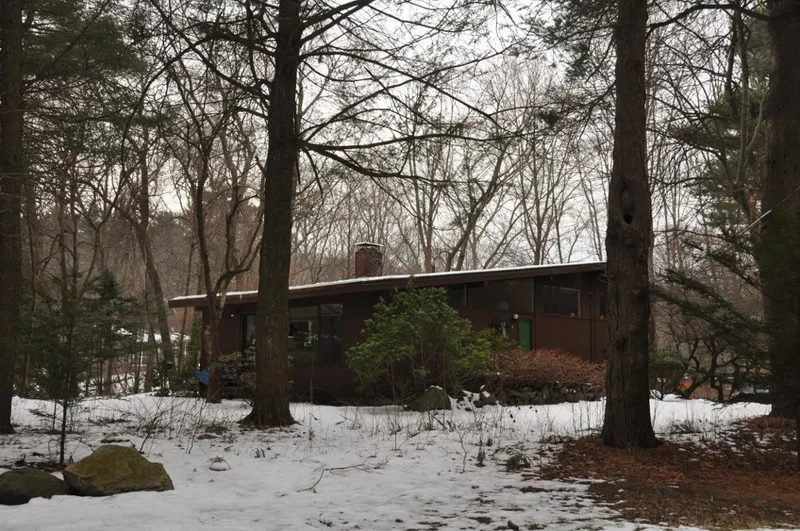
Peacock Farm is a wooded neighborhood in southeast Lexington, Massachusetts, laid out on a former working farm purchased in 1952. Houses were built between 1953 and 1960, most from a standard split-level design by Compton & Pierce featuring shallow-pitched asymmetric gable roofs, wide overhangs, bands of glass, vertical wood siding and a hearth-centered open plan. Seven earlier one-story A Series houses, a prefabricated Techbuilt house by Carl Koch, and several custom designs by Walter S. Pierce and Henry Hoover add variety. Houses are sited individually on sloping lots, with mirror-image plans and varied orientations avoiding repetition. The district also holds about seven acres of shared open land with trails, a picnic grove and a swimming pool dating from 1958. The ca. 1830 Federal/Greek Revival farmhouse and a ca. 1875 barn from the original farm still stand at the entrance. It was recognized as a planned Mid-Century Modern community that largely keeps its original character.
Machine-generated summary. This summary was generated by a language model from the official nomination document and has not been reviewed line by line by an editor. It may contain errors. Check the source document before relying on any detail. Source: nomination document (PDF) · catalog entry. Generated October 2026 (model claude-sonnet-5-5, prompt v1.0-2026-10-29).
| Styles | Modern Movement: Mid-Century Modern; Federal/Greek Revival (farmhouse) |
|---|---|
| Areas of significance | Architecture, Community Planning and Development, Landscape Architecture |
| Acreage | 45 |
| Boundary source | NPS cultural-resource GIS polygon |
| Full listing page | Peacock Farm Historic District (property record) |
What listing means for this property
This is a historic district. Buildings within its boundary are either contributing (they add to the district's significance) or non-contributing. Owners of contributing income-producing buildings can claim the 20% federal rehabilitation tax credit; homeowners should look at state credits. National Register districts impose no design review by themselves; a local historic district ordinance, if one exists, does (the difference explained).
General information, not legal or tax advice. Rules change; confirm with your State Historic Preservation Office or a qualified adviser.