Orange Center Historic District

Why it's listed
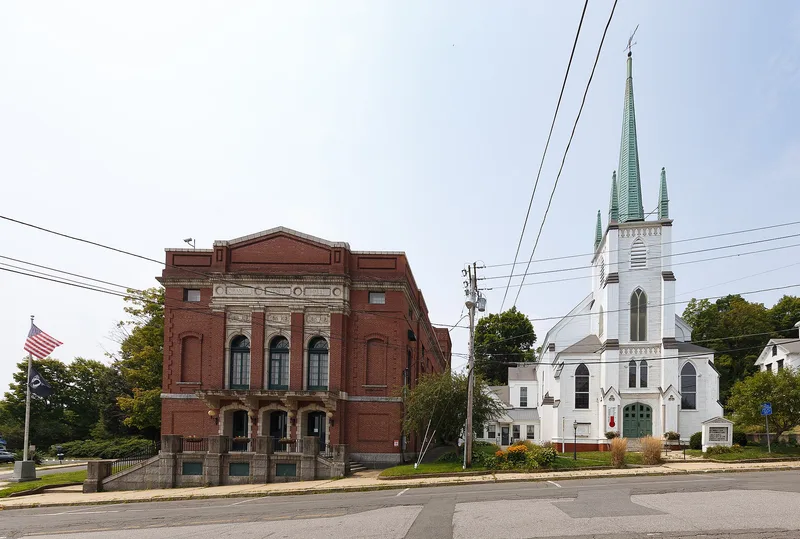
Orange Center is the commercial and civic heart of Orange, in the northeastern corner of Franklin County, Massachusetts. The twelve-acre district gathers around the crossing of North, South, East and West Main Streets and takes in part of Millers River. It holds 39 contributing resources, including the Town Hall, churches, banks, commercial blocks, a railroad freight house and the remains of sewing machine and turbine factories. Growth began in the late 1830s with the first Town Hall and accelerated after a railroad station opened in 1846. Furniture makers, turbine builders and especially the Gold Medal and later New Home Sewing Machine Company brought jobs and capital, and by 1890 New Home employed more than 600 people. The buildings trace changing tastes, from Greek Revival blocks of the 1840s to Victorian Gothic banks and Romanesque buildings of the 1890s, along with brick industrial buildings with elaborate ornament. A fire in 1891 led to rebuilding around the main intersection.
Machine-generated summary. This summary was generated by a language model from the official nomination document and has not been reviewed line by line by an editor. It may contain errors. Check the source document before relying on any detail. Source: nomination document (PDF) · catalog entry. Generated October 2026 (model claude-sonnet-5-5, prompt v1.0-2026-10-29).
| Styles | Mid-19th Century: Greek Revival, Gothic Revival, Italian Villa; Late Victorian: Second Empire, Victorian Gothic, Italianate, Richardsonian Romanesque; Commercial; Late 19th Century Industrial |
|---|---|
| Areas of significance | Industry, Commerce, Architecture |
| Acreage | 12 |
| Boundary source | NPS cultural-resource GIS polygon |
| Full listing page | Orange Center Historic District (property record) |
What listing means for this property
This is a historic district. Buildings within its boundary are either contributing (they add to the district's significance) or non-contributing. Owners of contributing income-producing buildings can claim the 20% federal rehabilitation tax credit; homeowners should look at state credits. National Register districts impose no design review by themselves; a local historic district ordinance, if one exists, does (the difference explained).
General information, not legal or tax advice. Rules change; confirm with your State Historic Preservation Office or a qualified adviser.