North Lexington Street Historic District

The National Park Service has not published a boundary polygon for this district; the map shows the listed properties inside it and the district's reference point.
Why it's listed
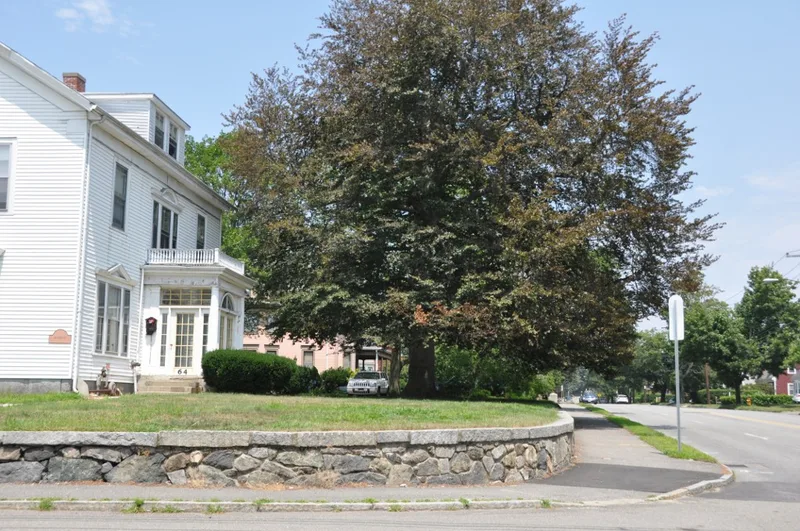
Along a busy stretch of Lexington Street in Waltham stand four large houses and a dairy barn that together recall a family milk business. The land was bought in 1681 by Jonathan Sanderson, but building began only after 1865, when blacksmith Elias B. Armstrong built the Italianate house at 508 Lexington. William G. Childs followed in 1873 with a Mansard house, moving his milk business there from Pond Street. His sons Arthur and William B. Childs built Colonial Revival houses on either side, in 1901 and between 1904 and 1907, and expanded the dairy after their father's death in 1902. Of the large complex of farm buildings behind the houses, only the barn, with twin cupolas and largely original clapboards, remains. The Childs Brothers business shifted partly to Somerville in the 1920s and closed in 1929. The district is notable because such a cohesive group of period houses and outbuildings is unusual on this now-modernized road.
Machine-generated summary. This summary was generated by a language model from the official nomination document and has not been reviewed line by line by an editor. It may contain errors. Check the source document before relying on any detail. Source: nomination document (PDF) · catalog entry. Generated October 2026 (model claude-sonnet-5-5, prompt v1.0-2026-10-29).
| Period of significance | 1860-1915 |
|---|---|
| Styles | Italianate, Mansard, Colonial Revival |
| Areas of significance | Community Planning and Development, Agriculture, Architecture |
| Acreage | 3.2 |
| Boundary source | not published |
| Full listing page | North Lexington Street Historic District (property record) |
What listing means for this property
This is a historic district. Buildings within its boundary are either contributing (they add to the district's significance) or non-contributing. Owners of contributing income-producing buildings can claim the 20% federal rehabilitation tax credit; homeowners should look at state credits. National Register districts impose no design review by themselves; a local historic district ordinance, if one exists, does (the difference explained).
General information, not legal or tax advice. Rules change; confirm with your State Historic Preservation Office or a qualified adviser.