North Attleborough Town Center Historic District

Why it's listed
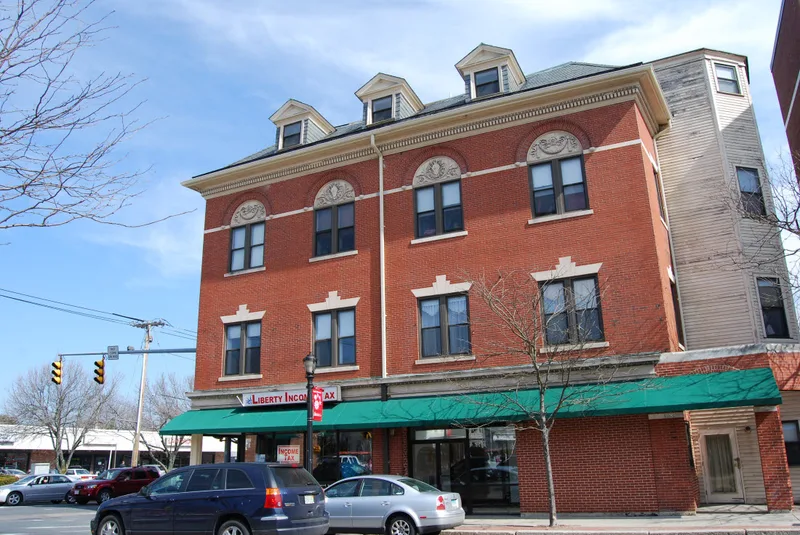
Downtown North Attleborough, Massachusetts, is a twenty-six-acre district strung along North and South Washington Streets. It holds fifty-two properties, mainly commercial, along with several residences, one church and a number of municipal buildings. The area grew as the business center of a town whose economy rested on jewelry manufacturing. Many of the large brick blocks replaced earlier frame buildings lost in a series of early 20th-century fires. The district's chief architectural strength is its group of red brick Georgian Revival and Classical Revival business and institutional buildings, some designed by Boston firms such as Hutchins and French. Notable examples include the 1894 Richards Memorial Library, the 1916 post office, the 1928 Hotel Hixon and the Bristol Lodge Masonic building. Local builder James A. Munroe built most of the stores on one side of North Washington Street. Six buildings of late 20th-century date are considered intrusions, and the Guild Block site is now a gap in the streetscape. Most buildings remain in good to excellent condition and in continuous use.
Machine-generated summary. This summary was generated by a language model from the official nomination document and has not been reviewed line by line by an editor. It may contain errors. Check the source document before relying on any detail. Source: nomination document (PDF) · catalog entry. Generated October 2026 (model claude-sonnet-5-5, prompt v1.0-2026-10-29).
| Styles | Georgian Revival, Classical Revival, Italianate, Colonial Revival, Gothic Revival, with vernacular Greek Revival, Italianate and Queen Anne residences |
|---|---|
| Areas of significance | Industry, Community Planning and Development, Commerce, Architecture |
| Acreage | 26 |
| Boundary source | NPS cultural-resource GIS polygon |
| Full listing page | North Attleborough Town Center Historic District (property record) |
What listing means for this property
This is a historic district. Buildings within its boundary are either contributing (they add to the district's significance) or non-contributing. Owners of contributing income-producing buildings can claim the 20% federal rehabilitation tax credit; homeowners should look at state credits. National Register districts impose no design review by themselves; a local historic district ordinance, if one exists, does (the difference explained).
General information, not legal or tax advice. Rules change; confirm with your State Historic Preservation Office or a qualified adviser.