Newtonville Historic District

Why it's listed
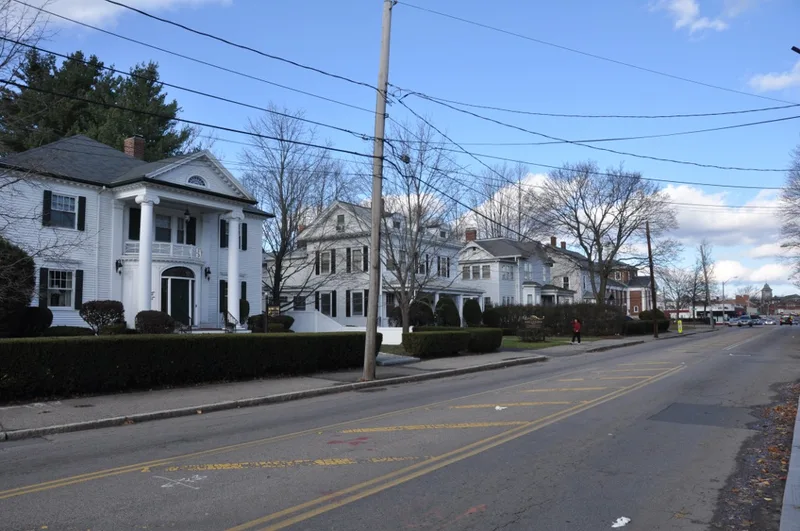
Newtonville Historic District covers about 40 acres of mostly residential streets in Newton, Massachusetts, with 143 properties arranged along Walnut Street, Highland Avenue and Otis Street. Once part of the Fuller and Hull farm, the area developed after the railroad depot opened in the 1840s, with most building taking place from the 1870s to about 1910. Developers such as Henry F. Ross, Royal M. Pulsifer and Fitzhugh Rollins laid out cul-de-sacs and small subdivisions that filled with houses. The streets show a clear sequence of styles: early Greek Revival and Italianate houses, a Tuscan villa, Stick Style and Mansard residences, elaborate Queen Anne homes, and later Shingle Style and Colonial Revival buildings. Two stone churches, including an early work by Ralph Adams Cram, and the 1891 Claflin School add institutional variety. About 29 properties are non-contributing, mostly later Colonial Revival houses. The district is listed for its representation of the village's formative growth and its architecture.
Machine-generated summary. This summary was generated by a language model from the official nomination document and has not been reviewed line by line by an editor. It may contain errors. Check the source document before relying on any detail. Source: nomination document (PDF) · catalog entry. Generated October 2026 (model claude-sonnet-5-5, prompt v1.0-2026-10-29).
| Period of significance | 1850-1910 |
|---|---|
| Styles | Greek Revival, Italianate, Gothic Revival, Stick Style, Mansard, Queen Anne, Shingle Style, Colonial Revival |
| Areas of significance | Community Planning and Development, Architecture |
| Acreage | 40.5 |
| Boundary source | NPS cultural-resource GIS polygon |
| Full listing page | Newtonville Historic District (property record) |
What listing means for this property
This is a historic district. Buildings within its boundary are either contributing (they add to the district's significance) or non-contributing. Owners of contributing income-producing buildings can claim the 20% federal rehabilitation tax credit; homeowners should look at state credits. National Register districts impose no design review by themselves; a local historic district ordinance, if one exists, does (the difference explained).
General information, not legal or tax advice. Rules change; confirm with your State Historic Preservation Office or a qualified adviser.