Newton Highlands Historic District

Why it's listed
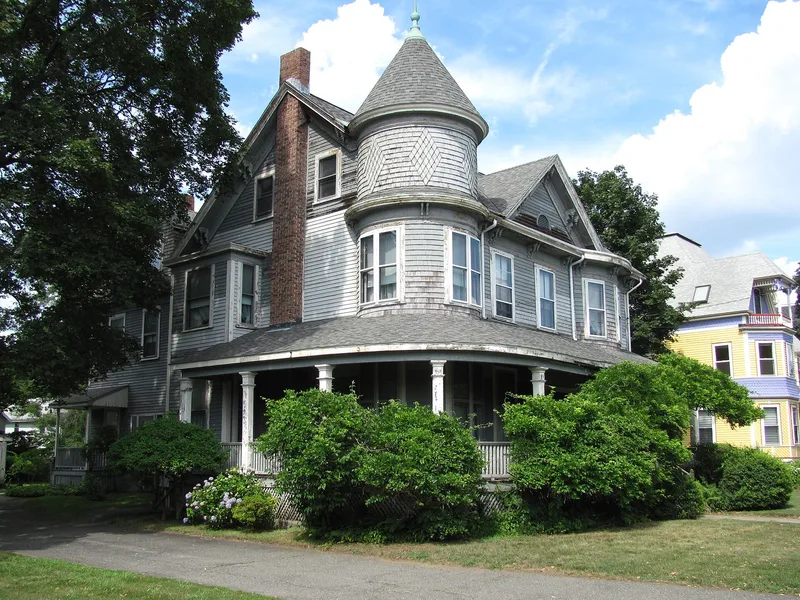
Newton Highlands Historic District is a compact residential neighborhood of about 16 acres and fifty properties, set on a sandy plateau west of the village center. Developers Samson D. Whittemore and Charles W. Farnham bought a 38-acre tract in 1870 and laid out most of the street system, in response to suburban rail service on the Highland Branch. Local builders such as Samuel A. Walker then put up speculative housing, and construction boomed after rail upgrades and streetcar lines arrived in the 1890s. Over 80 percent of the buildings date from 1870 to 1900. Queen Anne and Colonial Revival houses predominate, alongside Italianate, Gothic, Stick and Shingle Style examples. Two institutions anchor the eastern end: the Hyde School of 1895, damaged by fire in 1981, and the granite Congregational Church of 1907. The district is regarded as the earliest suburban development in the village, and its architecture reflects modest-income interpretations of fashionable designs.
Machine-generated summary. This summary was generated by a language model from the official nomination document and has not been reviewed line by line by an editor. It may contain errors. Check the source document before relying on any detail. Source: nomination document (PDF) · catalog entry. Generated October 2026 (model claude-sonnet-5-5, prompt v1.0-2026-10-29).
| Period of significance | 1870-1907 |
|---|---|
| Styles | Queen Anne and Colonial Revival predominate, with Italianate, Tuscan villa, mansard, Carpenter Gothic, Stick Style, Shingle Style and Romanesque examples |
| Areas of significance | Community Planning and Development, Transportation, Architecture |
| Acreage | 15.9 |
| Boundary source | NPS cultural-resource GIS polygon |
| Full listing page | Newton Highlands Historic District (property record) |
What listing means for this property
This is a historic district. Buildings within its boundary are either contributing (they add to the district's significance) or non-contributing. Owners of contributing income-producing buildings can claim the 20% federal rehabilitation tax credit; homeowners should look at state credits. National Register districts impose no design review by themselves; a local historic district ordinance, if one exists, does (the difference explained).
General information, not legal or tax advice. Rules change; confirm with your State Historic Preservation Office or a qualified adviser.