Needham Town Hall Historic District

Why it's listed
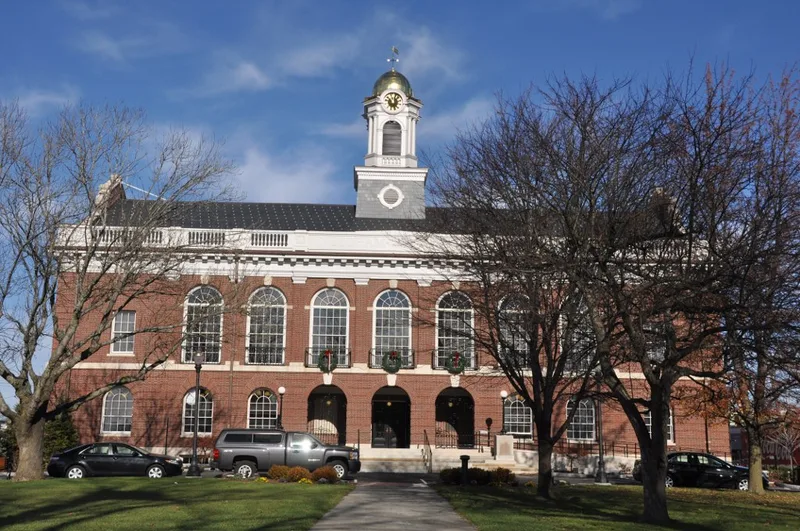
Needham's civic center sits on about one acre where Great Plain Avenue, Highland Avenue and Chapel Street meet. It combines a large Georgian Revival Town Hall with the open Town Common to its south. The two-and-a-half-story brick hall has a granite foundation, slate roof, stone stringcourses, an arcaded entrance loggia, large round-headed second-story windows and a clock-bearing cupola. Winslow & Bigelow and builder Henry F. Bigelow are named, and the cornerstone was laid in 1902. The town bought the Common land, formerly part of the Davis farm, in 1884, and monuments and markers were added through 1930. The center shifted here after railroad lines crossed nearby in the 1850s, and the downtown commercial district grew around it. The hall still houses municipal offices, though the old second-floor assembly room has been divided into offices. A flagpole and memorial wall were added later. The district was recognized for its architecture and its role in the town's planning and government.
Machine-generated summary. This summary was generated by a language model from the official nomination document and has not been reviewed line by line by an editor. It may contain errors. Check the source document before relying on any detail. Source: nomination document (PDF) · catalog entry. Generated October 2026 (model claude-sonnet-5-5, prompt v1.0-2026-10-29).
| Period of significance | 1884-1930 |
|---|---|
| Styles | Late 19th Century Revivals/Georgian Revival |
| Areas of significance | Community Planning and Development, Politics/Government, Architecture |
| Acreage | 1 |
| Boundary source | NPS cultural-resource GIS polygon |
| Full listing page | Needham Town Hall Historic District (property record) |
What listing means for this property
This is a historic district. Buildings within its boundary are either contributing (they add to the district's significance) or non-contributing. Owners of contributing income-producing buildings can claim the 20% federal rehabilitation tax credit; homeowners should look at state credits. National Register districts impose no design review by themselves; a local historic district ordinance, if one exists, does (the difference explained).
General information, not legal or tax advice. Rules change; confirm with your State Historic Preservation Office or a qualified adviser.