Mt. Vernon Street Historic District

Why it's listed
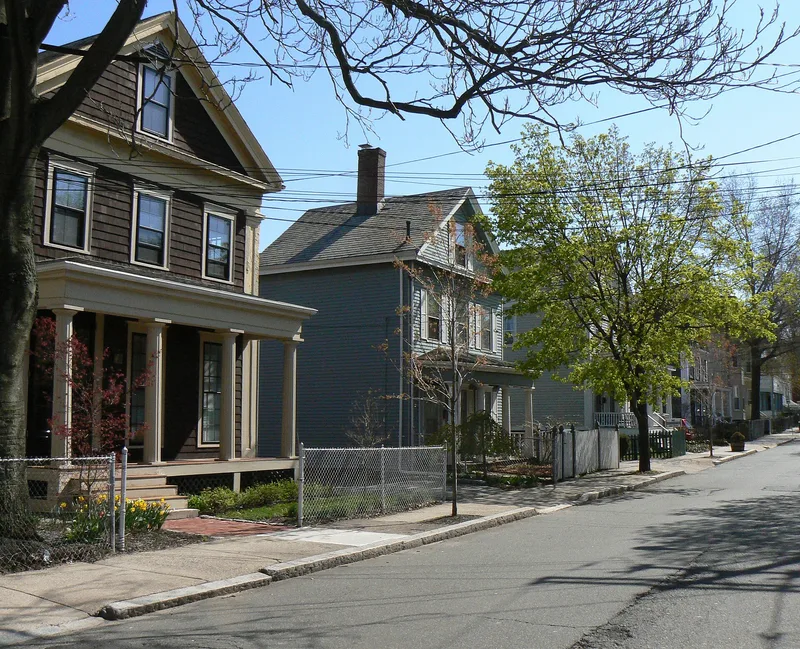
Mt. Vernon Street in East Somerville holds a compact group of seven buildings, most built by 1855, that together form Somerville's most intact collection of modest Greek Revival houses. The street was platted in 1845 near the Charlestown line and a Boston and Maine Railroad passenger station built in 1835. The railroad brought businessmen and artisans from Boston and Charlestown into the area then called the Neck. Four of the houses are Greek Revival cottages with side-hall plans, three-bay facades and full-length porches on Doric-like columns. Early residents included a Boston marine inspector and a bleachery worker. The group also includes a Federal house that predates the Greek Revival buildings, an Italianate house, and a Second Empire double house with a mansard roof from about 1880, which reflects the later shift toward apartment housing. A 1940s garage is the only non-contributing resource. The buildings have kept their form with little alteration, preserving the feel of the original streetscape.
Machine-generated summary. This summary was generated by a language model from the official nomination document and has not been reviewed line by line by an editor. It may contain errors. Check the source document before relying on any detail. Source: nomination document (PDF) · catalog entry. Generated October 2026 (model claude-sonnet-5-5, prompt v1.0-2026-10-29).
| Period of significance | ca. 1830 - 1880 |
|---|---|
| Styles | Greek Revival (with one Federal house, one Italianate house and one Second Empire double house) |
| Areas of significance | Community Planning and Development, Architecture |
| Acreage | 1 |
| Boundary source | NPS cultural-resource GIS polygon |
| Full listing page | Mt. Vernon Street Historic District (property record) |
What listing means for this property
This is a historic district. Buildings within its boundary are either contributing (they add to the district's significance) or non-contributing. Owners of contributing income-producing buildings can claim the 20% federal rehabilitation tax credit; homeowners should look at state credits. National Register districts impose no design review by themselves; a local historic district ordinance, if one exists, does (the difference explained).
General information, not legal or tax advice. Rules change; confirm with your State Historic Preservation Office or a qualified adviser.