Knollwood

Why it's listed
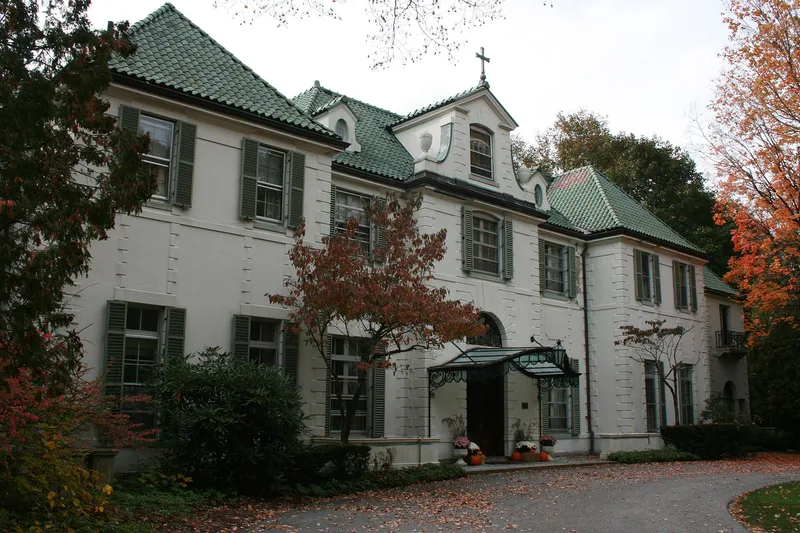
Knollwood is a former country estate on Salisbury Street in Worcester, now a district of about 15 acres. It was carved from the 122-acre estate of industrialist Lyman Gordon, a founder of Wyman & Gordon Co. The main house, built in 1914 by the Boston firm Little & Brown, is a stucco-covered, hip-roofed mansion modeled on French manor houses and approached by an allee of trees. Its ornamental iron canopy came from the W. A. Snow Iron Works and appeared in a 1915 trade catalogue. Around it survive a smaller second house, three employee cottages, two former stable and service buildings, garden walls, gate posts and tree-lined drives, all from the same design. Gordon died as the house neared completion. Later owners included Lucius Knowles of Crompton & Knowles Loom Works and art collector Theodore Ellis. Much of the land was subdivided for house lots, and since the early 1950s the main house has served as a girls' school. A 1954 school building is not considered contributing.
Machine-generated summary. This summary was generated by a language model from the official nomination document and has not been reviewed line by line by an editor. It may contain errors. Check the source document before relying on any detail. Source: nomination document (PDF) · catalog entry. Generated October 2026 (model claude-sonnet-5-5, prompt v1.0-2026-10-29).
| Styles | Based on 17th and 18th century French manor house architecture; stucco-covered buildings with hip roofs |
|---|---|
| Areas of significance | Architecture |
| Acreage | 15 |
| Boundary source | NPS cultural-resource GIS polygon |
| Full listing page | Knollwood (property record) |
What listing means for this property
This is a historic district. Buildings within its boundary are either contributing (they add to the district's significance) or non-contributing. Owners of contributing income-producing buildings can claim the 20% federal rehabilitation tax credit; homeowners should look at state credits. National Register districts impose no design review by themselves; a local historic district ordinance, if one exists, does (the difference explained).
General information, not legal or tax advice. Rules change; confirm with your State Historic Preservation Office or a qualified adviser.