Hubbard Park Historic District

The National Park Service has not published a boundary polygon for this district; the map shows the listed properties inside it and the district's reference point.
Why it's listed
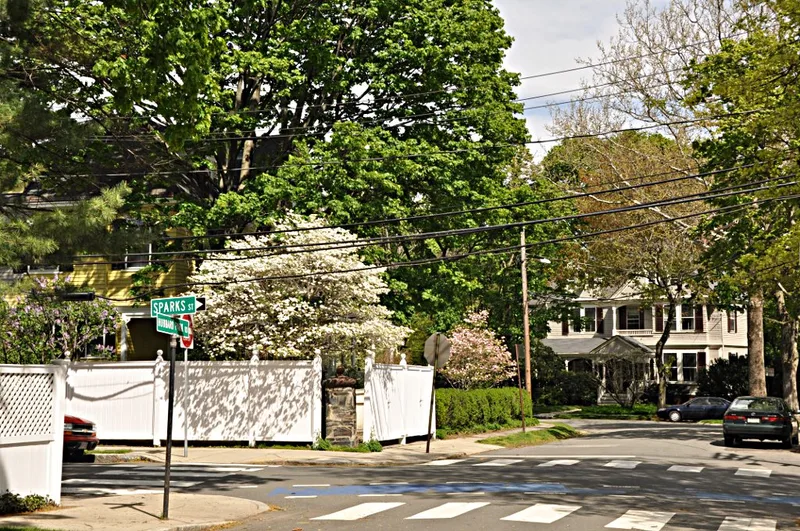
Hubbard Park is a residential enclave in Cambridge, Massachusetts, laid out on the grounds of Gardiner Hubbard's estate. Hubbard reserved six acres for his 1850 mansion at 146 Brattle Street. Beginning in 1886 he commissioned leading architects to design a ring of fine houses linked by a sweeping driveway around the park. The arrangement gave the grounds a dignified unity and screened off the more modest Foster Street neighborhood to the south. The mansion was demolished in 1939, but the park survives in the form completed by 1907. Most houses are Queen Anne, with notable Colonial Revival examples by Longfellow, Alden & Harlow, and a few Tudor Revival and Georgian Revival designs. Development proceeded slowly rather than with the rapid pace of typical real estate promotion. Hubbard was a civic-minded figure who promoted the local gas company, waterworks and horse-car line, and was later linked to the telephone company and the National Geographic Society. The district includes Hubbard Park, Mercer Circle and part of Sparks Street.
Machine-generated summary. This summary was generated by a language model from the official nomination document and has not been reviewed line by line by an editor. It may contain errors. Check the source document before relying on any detail. Source: nomination document (PDF) · catalog entry. Generated October 2026 (model claude-sonnet-5-5, prompt v1.0-2026-10-29).
| Period of significance | 1886-1907 |
|---|---|
| Styles | Queen Anne and Colonial Revival |
| Areas of significance | Community Planning and Development, Architecture |
| Acreage | 6.8 |
| Boundary source | not published |
| Full listing page | Hubbard Park Historic District (property record) |
What listing means for this property
This is a historic district. Buildings within its boundary are either contributing (they add to the district's significance) or non-contributing. Owners of contributing income-producing buildings can claim the 20% federal rehabilitation tax credit; homeowners should look at state credits. National Register districts impose no design review by themselves; a local historic district ordinance, if one exists, does (the difference explained).
General information, not legal or tax advice. Rules change; confirm with your State Historic Preservation Office or a qualified adviser.